

For decades, managing diabetes meant pricking your finger several times a day, hoping the tiny drop of blood told you enough. But today, that’s changing-fast. People with diabetes now have tools that don’t just measure glucose; they predict it, explain it, and even help you respond to it before you feel sick. Continuous Glucose Monitors (CGMs), smart insulin pens, and connected apps are no longer luxury gadgets. They’re becoming standard care. And for good reason.
What CGMs Really Do (And Why They’re a Game-Changer)
Continuous Glucose Monitors (CGMs) aren’t just fancy fingerstick replacements. They’re tiny sensors worn on the arm or belly that measure glucose in the fluid between your cells every five minutes, 24/7. That’s 288 readings a day. Compare that to the four or five you used to get from a meter. Suddenly, you see patterns you never knew existed: why your blood sugar spiked after a walk, dropped overnight without warning, or climbed after a coffee you thought was sugar-free.
The American Diabetes Association now recommends CGMs for everyone with Type 1 diabetes, anyone with Type 2 on insulin, pregnant people, older adults at risk for low blood sugar, and even children from diagnosis. Why? Because numbers don’t lie. A 2025 study showed CGM users spend 3.2 more hours per day in the safe glucose range (70-180 mg/dL) than those still using fingersticks. That’s not just convenience-it’s protection. Each 10% increase in time in range cuts microvascular complications like nerve and kidney damage by 64%.
The top CGMs today are Dexcom G7, Abbott FreeStyle Libre 3, and Medtronic Guardian 4. Abbott’s Libre 3 has a MARD score of 8.1%, meaning its readings are, on average, within 8.1% of a lab test. Dexcom’s G7 lasts 10 days and doesn’t need a separate receiver-your phone does it all. Medtronic’s sensor lasts a week but integrates tightly with insulin pumps. And then there’s what’s coming: Glucotrack, an implantable sensor about the size of three nickels, designed to sit under the skin and measure glucose directly from blood. No lag. No interstitial fluid delay. Clinical trials show a MARD of 7.7%, and if approved in 2028, it could prevent thousands of severe low-blood-sugar events every year.
Smart Pens: The Quiet Helper Nobody Talks About
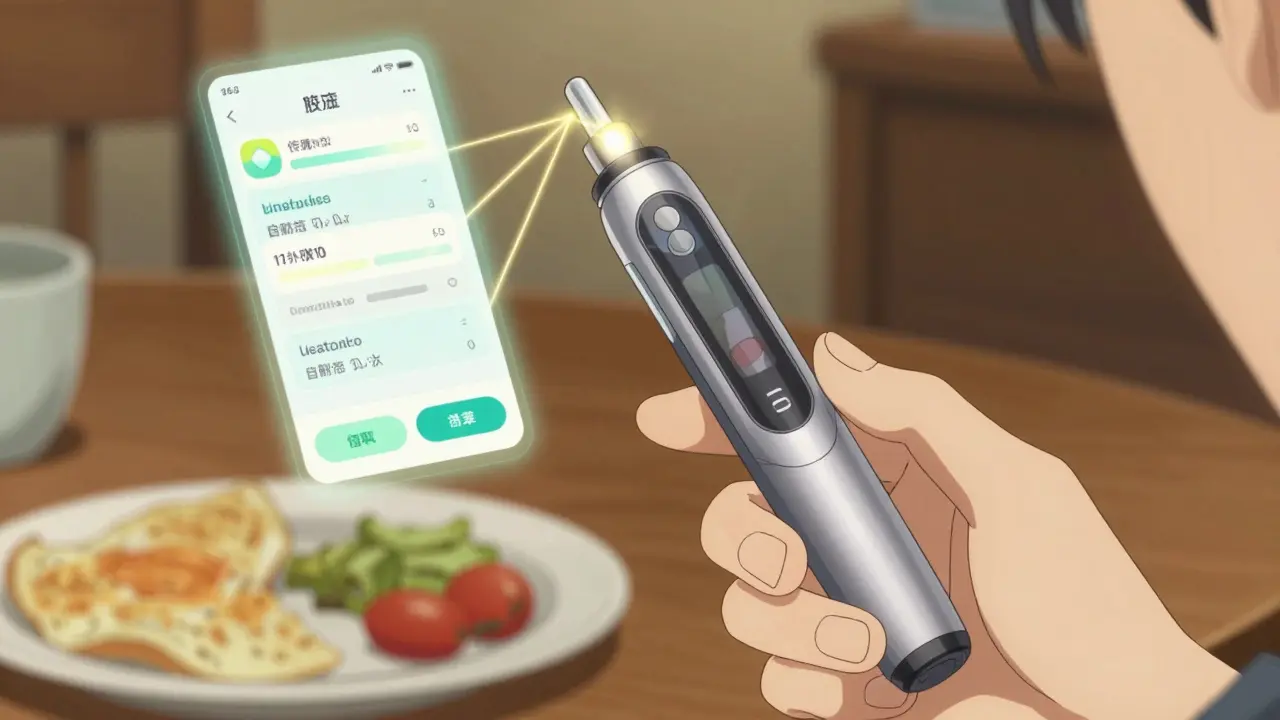
While CGMs get all the attention, smart insulin pens are quietly changing how people dose. The InPen by Medtronic isn’t just a pen with Bluetooth. It remembers every dose, tracks insulin-on-board, and calculates suggested doses based on your CGM data. If your glucose is rising fast, it tells you how much insulin to give. If you’re low, it warns you not to inject. And it syncs with apps so your care team can see what’s happening-even if you forget to log it.
Yet adoption is still low. Only 15% of insulin users use smart pens, according to 2025 data from the American Association of Diabetes Care & Education Specialists. Why? Cost. Complexity. Lack of awareness. Many doctors still hand out pens without explaining they can connect. But for people who forget doses, struggle with carb counting, or live with unpredictable schedules, this is a lifeline. One user in Seattle told me she went from 10% A1c to 6.9% in six months after pairing her Libre 3 with InPen. She didn’t change her diet. She just stopped guessing.
Apps That Actually Work (And the Ones That Don’t)
There are hundreds of diabetes apps. Most are cluttered, disconnected, or just glorified logbooks. But the ones that matter? They talk to your CGM and your insulin pen. mySugr, One Drop, and Tidepool are the leaders here. They don’t just show numbers-they turn them into stories. You see trends. You get alerts. You share data with your doctor without calling in.
But here’s the catch: only 43% of third-party apps integrate fully with all major CGMs. If you’re using Dexcom, Abbott, and Medtronic, you might need two different apps. That’s frustrating. And dangerous. One 2025 survey found that 38% of users stopped using their app because it didn’t sync reliably. The best apps now use open protocols like Apple Health and Google Fit to pull data from anywhere. They also let you tag events: “ate pizza,” “ran 5K,” “stressful meeting.” Machine learning models trained on this data can predict glucose changes up to 30 minutes ahead. Dexcom and EarlySense are rolling this out in Q2 2026.
The Real Cost-And Who’s Getting Left Behind
Let’s be honest: CGMs aren’t cheap. A sensor can cost $150-$300. Without insurance, that’s $300 a month. Even with Medicare and Medicaid expansions, 41% of low-income patients still can’t access them. And insurance denials? They’re common. In 2025, 37% of commercially insured patients reported prior authorization rejections. Some insurers still treat CGMs as “optional,” despite the ADA’s clear stance.
And then there’s the hidden cost: data overload. New users often get 10-15 alerts a day. Nighttime alarms, high alerts, low alerts. Many panic. Some quit. The ADA now recommends personalized alerts-not default settings. A night-shift worker needs different warnings than a parent with three kids. One study found that 68% of new users experienced alarm fatigue before learning to customize. That’s why training matters. People who get 3-5 hours of structured education are 78% more likely to stick with CGMs long-term.

What’s Next? Implants, AI, and Needle-Free Insulin
The future isn’t just better sensors-it’s smarter systems. Glucotrack’s implantable sensor could eliminate the biggest flaw in current CGMs: the 5-15 minute lag between blood glucose and what the sensor reads. If it works, it could prevent thousands of hypoglycemic emergencies every year. Meanwhile, Vaxess Technologies is developing a needle-free patch for semaglutide (Ozempic), which could solve adherence problems for millions using GLP-1 drugs. And AI? It’s already here. Predictive algorithms using your glucose history, activity, and meals are now 89% accurate in forecasting highs and lows 30 minutes out.
But the biggest hurdle isn’t tech. It’s access. A 2025 JAMA study found 63% of CGM systems had data security flaws-meaning someone could theoretically manipulate your glucose readings. And while 68% of large U.S. healthcare systems now offer remote CGM monitoring, rural clinics and safety-net hospitals still lag behind. The technology is ready. The systems aren’t.
Real Lives, Real Changes
One 2025 program tracked 200 underserved patients using remote CGM monitoring. No clinic visits. Just a sensor, a phone, and a care coordinator. In three months, their average A1c dropped from 10.4% to 7.5%. Foot ulcers healed 72% faster. People slept better. Anxiety dropped. One woman, a single mom in Arizona, said, “I stopped being scared of the night. Now I know what’s coming.”
These aren’t futuristic dreams. They’re happening now. CGMs, smart pens, and apps aren’t just tools-they’re bridges between fear and control. Between guesswork and confidence. Between survival and living.
Are CGMs covered by insurance?
Yes, most major insurers-including Medicare and Medicaid-cover CGMs for people with Type 1 diabetes and those with Type 2 on insulin. However, prior authorization is often required, and denials still happen. If you’re denied, ask for a letter of medical necessity from your provider. Some manufacturers also offer patient assistance programs to help with out-of-pocket costs.
Can I use a CGM without a smartphone?
Some older models require a separate receiver, but newer systems like Dexcom G7 and Abbott Libre 3 work directly with smartphones. If you don’t use a smartphone, you can still use a CGM, but you’ll miss out on alerts, trends, and data sharing. A few devices, like the Medtronic Guardian 4, offer a basic handheld reader as an alternative.
Do smart pens replace insulin pumps?
No. Smart pens record and calculate doses but don’t deliver insulin automatically. Insulin pumps (like Tandem’s t:slim X2) deliver insulin continuously and can adjust doses based on CGM data. Smart pens are for people who still give manual injections but want better tracking and dosing guidance. Many people use both-a pump for basal insulin and a smart pen for correction doses.
Which CGM is the most accurate?
The Abbott FreeStyle Libre 3 and Dexcom G7 are currently the most accurate, both with MARD scores under 9%. Glucotrack’s implantable sensor, still in trials, has shown a MARD of 7.7%, which could make it the most accurate once available. Accuracy matters most during rapid changes-like after meals or exercise-where lag time can affect safety.
Can I swim or shower with a CGM?
Yes. All current CGMs are waterproof for at least 30 minutes at depths up to 8 feet. You can swim, shower, and sweat without removing them. But adhesion can be an issue-especially in heat or humidity. Using skin prep wipes or adhesive patches can help. Some users report sensor detachment during intense workouts or in summer months.
Are there any downsides to using CGMs?
Yes. CGMs can cause anxiety if you fixate on every number. They’re not 100% perfect-lag time and occasional inaccuracies happen. Sensor adhesion can fail, especially during exercise or in hot weather. And if you don’t learn how to interpret the data, you might overreact to normal fluctuations. Training and personalized alerts are key to avoiding burnout.
What should I do if my CGM gives a weird reading?
Always confirm with a fingerstick if the reading seems off-especially if you’re feeling symptoms of low or high blood sugar. CGMs measure interstitial fluid, not blood, so there’s a slight delay. If you get a strange reading twice in a row, check the sensor placement, replace the sensor, or contact customer support. Most manufacturers offer 24/7 support.
Can I use a CGM if I don’t take insulin?
Yes. While CGMs were originally for insulin users, the ADA now recommends them for anyone with Type 2 diabetes who wants better control-even without insulin. Many people use them to understand how food, stress, or sleep affects their glucose. It’s not just for treatment-it’s for learning.










Mary Beth Brook
March 9, 2026 AT 05:01 AMCGMs are just another corporate cash grab disguised as innovation. They’re not improving outcomes-they’re creating data addicts who panic over a 5-point fluctuation. The ADA’s recommendation? More like a pharmaceutical lobbying win. Real medicine doesn’t need 288 readings a day-it needs discipline, diet, and damnit, some old-school willpower.
Janelle Pearl
March 10, 2026 AT 20:27 PMMy sister went from 10.8% A1c to 6.7% in 8 months with a Libre 3 and some basic coaching. No diet overhaul. No keto. Just seeing patterns. I used to think tech was overkill… until I saw her sleep through the night without a panic alarm. 🙌
Philip Mattawashish
March 11, 2026 AT 14:40 PMYou think this is progress? It’s surveillance capitalism with a glucose monitor. Every reading is harvested. Every alert is a data point sold to insurers who’ll jack up premiums next year. And don’t get me started on how they’re training kids to fear their own bodies. This isn’t healthcare-it’s behavioral conditioning wrapped in Bluetooth.
Samantha Fierro
March 12, 2026 AT 14:17 PMFor those feeling overwhelmed by alerts: start with one. Just one. Maybe only nighttime lows. Let your brain adjust. Then add another. You don’t need to consume every number-just the ones that matter to *your* life. This tech is a tool, not a tyrant.
Ray Foret Jr.
March 13, 2026 AT 15:01 PMJust got my G7 last week. First night, it woke me up at 3am because my sugar was at 62. I didn’t even know I was low! Now I’m hooked. 😍 Also, the app auto-logs my coffee-how is that even magic? 🤯
Dan Mayer
March 14, 2026 AT 14:35 PMAnyone else notice how Dexcom and Abbott are the only ones with real accuracy? Medtronic’s sensor is a joke. And Glucotrack? Yeah right, implantable sensor in 2028. More like 2035 after the FDA drags its feet. And don’t even get me started on how the FDA approves stuff now-like, last week they greenlit a glucose patch that had a 12% MARD. 12%! That’s worse than my old meter.
Neeti Rustagi
March 15, 2026 AT 08:48 AMWhile technological advancements are commendable, we must not overlook the foundational pillars of health: nutrition, movement, and mindful awareness. A sensor may guide, but wisdom must come from within. In India, we have long practiced Ayurvedic glucose regulation through turmeric, fenugreek, and daily walks at dawn. Technology should complement, not replace, this ancient wisdom.
Nicholas Gama
March 16, 2026 AT 08:35 AMCGMs are for people who can’t handle responsibility. If you need a phone to tell you not to eat a bagel, maybe you shouldn’t be eating bagels. This isn’t innovation-it’s infantilization. And don’t get me started on the alarm fatigue. Everyone’s a hypochondriac now.
Tom Sanders
March 16, 2026 AT 17:48 PMYeah but like… how much does this stuff actually cost? I’m not even gonna bother. My cousin got denied by insurance twice. She’s just winging it with a meter and prayer. Honestly? We’re leaving people behind.
Judith Manzano
March 18, 2026 AT 01:32 AMI’ve been using a Libre 3 for a year now. I never realized how much my stress spikes my sugar until I saw the graph after a bad Zoom call. Or how my 10-minute walk after dinner drops it 30 points. This isn’t about control-it’s about understanding. And honestly? It’s kind of beautiful.