
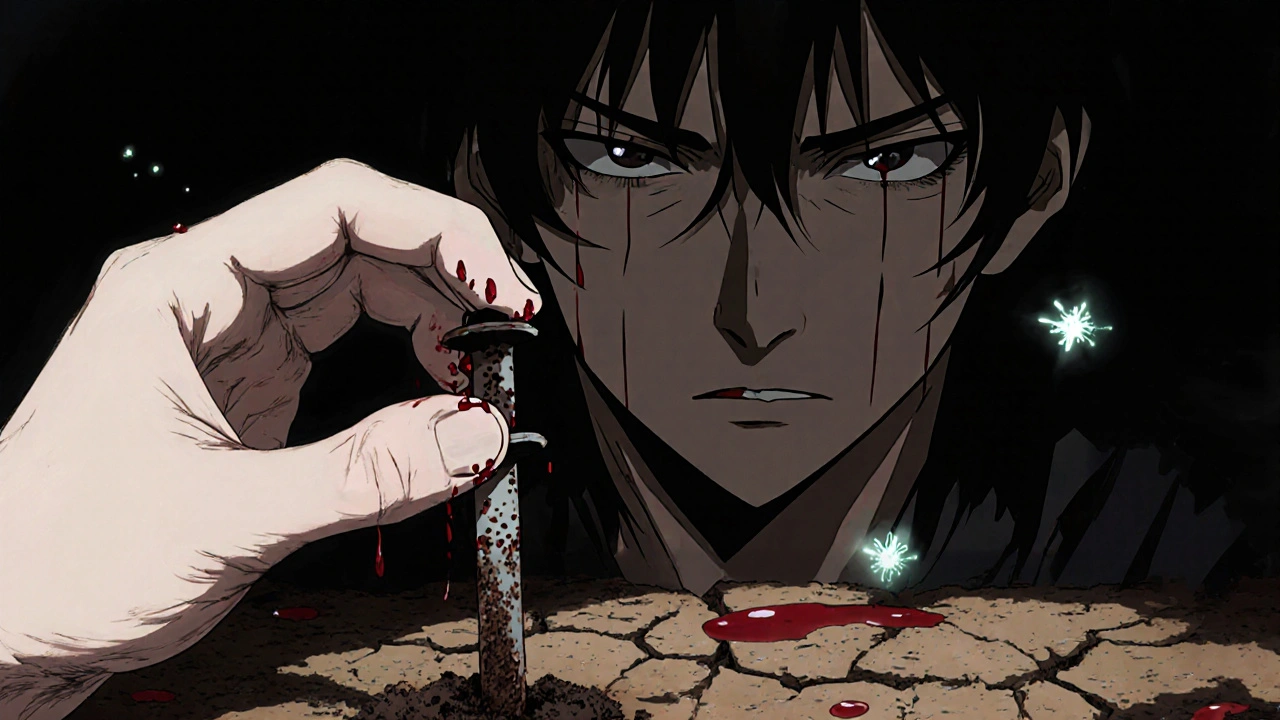
Tetanus doesn’t come with a warning. One tiny cut from a rusty nail, a splinter from old wood, or even a scrape from dirt-covered ground can set off a chain reaction in your body that leads to painful muscle spasms, locked jaws, and breathing trouble. It’s not contagious, but it’s deadly if ignored. Every year in the U.S., about 30 cases of tetanus are reported - and nearly one in five of those people don’t survive. The good news? It’s almost entirely preventable. Understanding how tetanus works, what it does to your body, and how to treat it can make all the difference.
How Tetanus Starts: It’s Not Just Rust
Many people think tetanus comes from rust. That’s a myth. Rust doesn’t cause tetanus. The real culprit is a bacterium called Clostridium tetani a spore-forming, anaerobic bacterium found in soil, dust, and animal feces. These spores are everywhere - in your garden, on tools, even in the dirt under your fingernails. They’re tough. They survive boiling, drying, and disinfectants. They only wake up when they find a deep, oxygen-poor wound - like a puncture from a nail, a burn, or a crush injury.
Once inside, the bacteria multiply and release a powerful toxin called tetanospasmin. This toxin travels through your nerves to your spinal cord and brain. It doesn’t infect your blood like other bacteria. Instead, it hijacks your nervous system. That’s why symptoms show up in your muscles, not your skin or organs.
What Tetanus Does to Your Body
The first sign is often stiffness in your jaw - that’s why it’s sometimes called "lockjaw." You might find it hard to open your mouth, chew, or swallow. Within days, the stiffness spreads. Your neck gets tight. Your back arches. Your abdomen feels rigid. Muscle spasms come on suddenly, triggered by loud noises, bright lights, or even a draft. These spasms aren’t just uncomfortable - they’re violent. They can break bones, tear muscles, and stop you from breathing.
Other symptoms include:
- Difficulty swallowing
- Fever and sweating
- Rapid heartbeat
- High blood pressure
- Facial grimacing (called risus sardonicus)
Without treatment, tetanus can lead to respiratory failure, heart rhythm problems, and death. Even with modern care, recovery takes weeks to months. Some people need weeks on a ventilator. Others never fully regain their muscle control.
How Tetanus Is Diagnosed
There’s no blood test for tetanus. Doctors don’t look for the bacteria in your blood. They look at your symptoms and your vaccination history. If you have stiff muscles, spasms, and haven’t had a tetanus shot in the last 10 years - especially after a dirty wound - tetanus is the likely diagnosis. Imaging or lab tests might be done to rule out other conditions like meningitis or rabies, but they won’t confirm tetanus. The diagnosis is clinical: based on what you’re showing and what you’ve been through.

Treatment: It’s Not Just Antibiotics
Treating tetanus is intensive. It’s not something you fix with a pill at home. If tetanus is suspected, you’re admitted to the hospital - often the ICU. Treatment has four main parts:
- Wound care: The infected wound is cleaned deeply. Dead tissue is removed. Sometimes surgery is needed.
- Tetanus immune globulin (TIG): This is antibodies pulled from human donors that neutralize the toxin already in your system. It doesn’t kill the bacteria, but it stops the toxin from doing more damage.
- Antibiotics: Penicillin or metronidazole is given to kill the remaining bacteria. This stops more toxin from being made.
- Supportive care: Muscle relaxants, sedatives, and sometimes paralysis drugs are used to control spasms. You may need a breathing tube and ventilator. Heart rate and blood pressure are closely monitored.
Recovery can take months. Physical therapy is often needed to rebuild muscle strength. The good news? If you survive the first few weeks, your chances of full recovery are high.
The Best Defense: The Tetanus Vaccine
The only reliable way to avoid tetanus is vaccination. The tetanus vaccine is part of two combined shots: DTaP for children, protecting against diphtheria, tetanus, and pertussis and Tdap for teens and adults, with reduced doses of diphtheria and pertussis. After the initial childhood series, you need a booster every 10 years. If you have a dirty wound and it’s been more than 5 years since your last shot, you get another one right away.
Some people think they’re safe if they’ve never had a tetanus shot - maybe they grew up in a clean environment or never got a serious cut. That’s dangerous thinking. Tetanus spores are in the soil you walk on, the dirt on your vegetables, the rust on your bike chain. You don’t need to be in a war zone or work on a farm to be at risk.
Even if you’re 70 and think you’re too old for vaccines, you still need that booster. Immunity fades. The CDC recommends every adult get at least one Tdap shot, then Td boosters every 10 years. If you’re pregnant, you get Tdap during each pregnancy - it protects your newborn, too.
What to Do After a Wound
Not every cut needs emergency care. But if you have a wound that’s:
- Deep or punctured
- Dirty or contaminated with soil, manure, or saliva
- Caused by a bite
- Not cleaned properly
And you haven’t had a tetanus shot in the last 5-10 years - go to a clinic. Don’t wait. Don’t assume it’s "just a scratch." The bacteria can be there, waiting. Your doctor will clean the wound and decide if you need TIG or a booster.
At home, always clean wounds with soap and water. Use an antiseptic if you have one. Cover it with a clean bandage. But cleaning alone won’t stop tetanus if you’re not vaccinated.
Who’s at Risk Today?
Tetanus is rare in the U.S. - but not because people are lucky. It’s because most people are vaccinated. The real risk groups are:
- People over 60 who never got the full childhood series
- Immigrants from countries with low vaccination rates
- People who refuse vaccines for religious or personal reasons
- Those who skip booster shots
- People with diabetes or poor circulation - their wounds heal slower, giving bacteria more time to grow
Even in 2025, the majority of tetanus cases in the U.S. happen in unvaccinated or under-vaccinated adults. It’s not a disease of the past - it’s a disease of missed shots.
Myths About Tetanus
Let’s clear up some common misunderstandings:
- Myth: Only rusty metal causes tetanus. Fact: Any object covered in dirt, manure, or saliva can carry the bacteria. A thorn, a wooden splinter, or a cat scratch can be enough.
- Myth: You can’t get tetanus if you’ve had it before. Fact: Surviving tetanus doesn’t give you immunity. You still need vaccines.
- Myth: The vaccine is dangerous. Fact: Side effects are mild - sore arm, low fever. Serious reactions are extremely rare. The risk of tetanus is far greater.
- Myth: Natural remedies can treat tetanus. Fact: No herb, oil, or home remedy can neutralize tetanus toxin. Delaying medical care is deadly.
Can you get tetanus from a clean cut?
It’s extremely unlikely. Tetanus bacteria need a deep, oxygen-poor environment to grow. A shallow, clean cut exposed to air won’t support them. But if the wound is dirty, deep, or contaminated - even if it looks minor - you should check your vaccination status.
Is the tetanus shot painful?
Most people feel a brief sting, then mild soreness in the arm for a day or two. Swelling or redness at the injection site is normal. A low fever or headache can happen but is uncommon. These side effects are minor compared to the risk of tetanus, which can require weeks in the hospital.
How long does tetanus protection last?
Protection from the tetanus vaccine lasts about 10 years. After that, your immunity drops. That’s why boosters are recommended every decade. If you get a high-risk wound and it’s been more than 5 years since your last shot, you’ll get a booster then too.
Can tetanus be cured?
There’s no cure that reverses the damage. Treatment focuses on stopping the toxin’s effects, killing the bacteria, and supporting your body until it recovers. Recovery can take weeks to months. Many people fully recover with proper care, but it’s a long, difficult process. Prevention through vaccination is the only true "cure."
Do I need a tetanus shot after a dog bite?
Yes, if you’re not up to date on your tetanus vaccine. Dog bites can introduce bacteria from the mouth into deep tissue, creating the perfect environment for tetanus spores. Even if the dog is vaccinated, the bacteria can be in its saliva or on its teeth from the ground. Clean the wound and see a doctor to assess your vaccination status.
Next Steps: Protect Yourself
Check your vaccination record. If you’re not sure when your last tetanus shot was, call your doctor or check your immunization card. If you don’t have one, get a new series - it’s simple, safe, and life-saving. If you’re a parent, make sure your kids are on schedule with DTaP. If you’re over 50, don’t assume you’re safe. Tetanus doesn’t care how old you are. It only cares if you’re protected.
There’s no reason to risk it. A single shot, given every 10 years, stops a disease that can kill you in days. It’s one of the simplest, most effective things you can do for your health.








Donald Sanchez
November 20, 2025 AT 00:08 AMlol rust doesn't cause tetanus?? 🤡 i've been scared of rusty nails my whole life. turns out it's just dirt?? i'm gonna go hug a goat now. 🐐💩
Greg Knight
November 21, 2025 AT 21:07 PMI've seen this happen firsthand - my uncle got a splinter from an old fence post in '08, didn't think much of it, and by the time he got to the ER, his jaw was locked and his back was arched like a bow. They had to sedate him for three weeks, put him on a ventilator, and he still has tremors in his hands. It's not just a shot - it's a lifeline. If you're skipping boosters because you think you're 'too clean' or 'too old,' you're playing Russian roulette with your nervous system. The bacteria are in the soil you walk on, the dust on your bike, the grime under your fingernails. It doesn't care how 'healthy' you are. It just wants an anaerobic pocket to wake up in. Don't be the guy who says 'I'll get it done next month.'
rachna jafri
November 22, 2025 AT 22:02 PMThis is all a lie. The government doesn't want you to know that tetanus is caused by 5G towers and chemtrails. They use the 'rust myth' to distract you while Big Pharma sells you poison vaccines that contain microchips to track your muscle spasms. I've seen videos - people who never got shots live longer. The CDC is just scared of the truth. India knows this. We don't need your Western lies. Our grandmas cleaned wounds with turmeric and cow urine - and they lived to 110. You're being manipulated.
darnell hunter
November 24, 2025 AT 21:31 PMThe assertion that tetanus is 'almost entirely preventable' is statistically accurate, yet the rhetorical framing exhibits a concerning degree of alarmism. The mortality rate of approximately 20% is not insignificant; however, the conflation of vaccination status with moral responsibility is both logically flawed and socially counterproductive. One cannot reasonably infer personal negligence from biological exposure to Clostridium tetani spores, which are ubiquitous in the environment. The emphasis on individual action, while well-intentioned, obscures systemic healthcare access disparities.
Hannah Machiorlete
November 26, 2025 AT 05:47 AMI got a tetanus shot last year and my arm hurt for a week. I cried. I hate needles. I still think it's a scam. My cousin didn't get one and he's fine. Why do they keep pushing this? I just want to live my life without being scared of dirt.
Bette Rivas
November 26, 2025 AT 07:30 AMIt's important to clarify that tetanus immune globulin (TIG) doesn't replace vaccination - it's a temporary passive immunity measure. The vaccine, on the other hand, triggers active immunity by prompting your body to produce its own antibodies against tetanospasmin. That's why boosters are essential: your antibody titers naturally decline over time, and without reinforcement, you're vulnerable again. Also, many people don't realize that Tdap isn't just for adults - it's recommended during each pregnancy to protect newborns who are too young to be vaccinated. Maternal immunization is one of the most effective public health strategies we have for neonatal tetanus prevention, which still kills tens of thousands globally each year.
prasad gali
November 27, 2025 AT 15:04 PMThe pathophysiology of tetanospasmin involves presynaptic inhibition of GABA and glycine neurotransmitters at the spinal cord level, resulting in unchecked motor neuron excitation. The clinical presentation - risus sardonicus, opisthotonus, autonomic instability - is a direct consequence of disinhibition of spinal reflex arcs. Vaccination remains the only evidence-based intervention. Alternative modalities, including herbal or energetic therapies, lack mechanistic plausibility and peer-reviewed validation. In clinical practice, delay in TIG administration correlates directly with increased ICU length of stay and mortality.
Paige Basford
November 28, 2025 AT 01:44 AMI used to think I was fine because I never got a deep cut. Then I got a tiny scratch from my cat’s claw while cleaning her litter box - and I panicked. Turned out I hadn’t had a booster since 2015. Went to urgent care and got the shot. Honestly? It felt like a tiny pinch. No big deal. But now I check my vaccination card every year with my birthday. It’s just one of those things, like flossing. You don’t think about it until you need it.
Ankita Sinha
November 29, 2025 AT 05:35 AMI’m from rural India and we’ve always cleaned wounds with neem leaves and salt water. But after my brother got tetanus from a bamboo splinter, I learned the hard way: natural remedies help with healing, but they don’t stop the toxin. We rushed him to the city hospital - he spent 47 days in ICU. The vaccine saved my life, not just his. Now I go door to door in my village and explain: it’s not about trust in Western medicine, it’s about trust in science. One shot. Ten years. No fear.
Kenneth Meyer
November 30, 2025 AT 16:50 PMTetanus is a quiet reminder that nature doesn't negotiate. The bacteria don't care about your politics, your vaccine beliefs, or your clean living. They're ancient. They've outlasted empires. And they're waiting - in the soil beneath your feet, in the dust on your tools, in the forgotten corner of your garage. We like to think we've tamed the world, but tetanus reminds us: we're still just guests here. The vaccine isn't a weapon. It's a handshake with evolution - a way to say, 'I see you. I respect you. But I'm not dying because of you.'
Lauren Hale
December 2, 2025 AT 16:44 PMI work in a hospital and I’ve seen too many cases where people wait until it’s too late. One man came in with a tiny puncture from a rose thorn - he said he ‘didn’t want to bother’ getting a shot. By the time he got here, he couldn’t swallow. His family was in tears. I’m not here to shame anyone. But if you’ve ever had a loved one in the ICU because of something preventable - you don’t take chances. Get the shot. Clean the wound. Be the person who says ‘better safe than sorry.’ It’s not about fear. It’s about love.
Jonathan Gabriel
December 4, 2025 AT 04:38 AMso the real villain isn't rust... it's the government's fearmongering about 'dirty wounds' to sell more vaccines. genius. next they'll say my cat's sneeze gives me rabies. 🤡
Don Angel
December 4, 2025 AT 11:54 AMI got a tetanus shot last week. My arm is sore. But I’m alive. And my kid’s vaccinated. And I’m not scared of dirt. I’m scared of ignorance. And I’m not going to let it kill me.
benedict nwokedi
December 5, 2025 AT 05:50 AMThis entire narrative is a corporate psyop. The CDC, WHO, and Big Pharma are colluding to create perpetual dependency on vaccines - funded by the Illuminati’s globalist agenda. The spores? They’re engineered. The ‘boosters’? They’re tracking devices. The ‘symptoms’? Placebo-induced mass hysteria. You think you’re safe because you got a shot? You’re just another sheep in the vaccine pasture.
deepak kumar
December 5, 2025 AT 09:19 AMIn India, we call tetanus 'lockjaw' - and our elders used to say, 'A clean cut is safe, but a dirty one is a silent enemy.' We didn't have vaccines in the villages, so we used turmeric, honey, and neem. But now, I take my children to the clinic every 10 years. Why? Because science doesn't replace tradition - it protects it. My grandmother survived the 1970s without a shot. But my daughter? She doesn't have to. That's progress.