
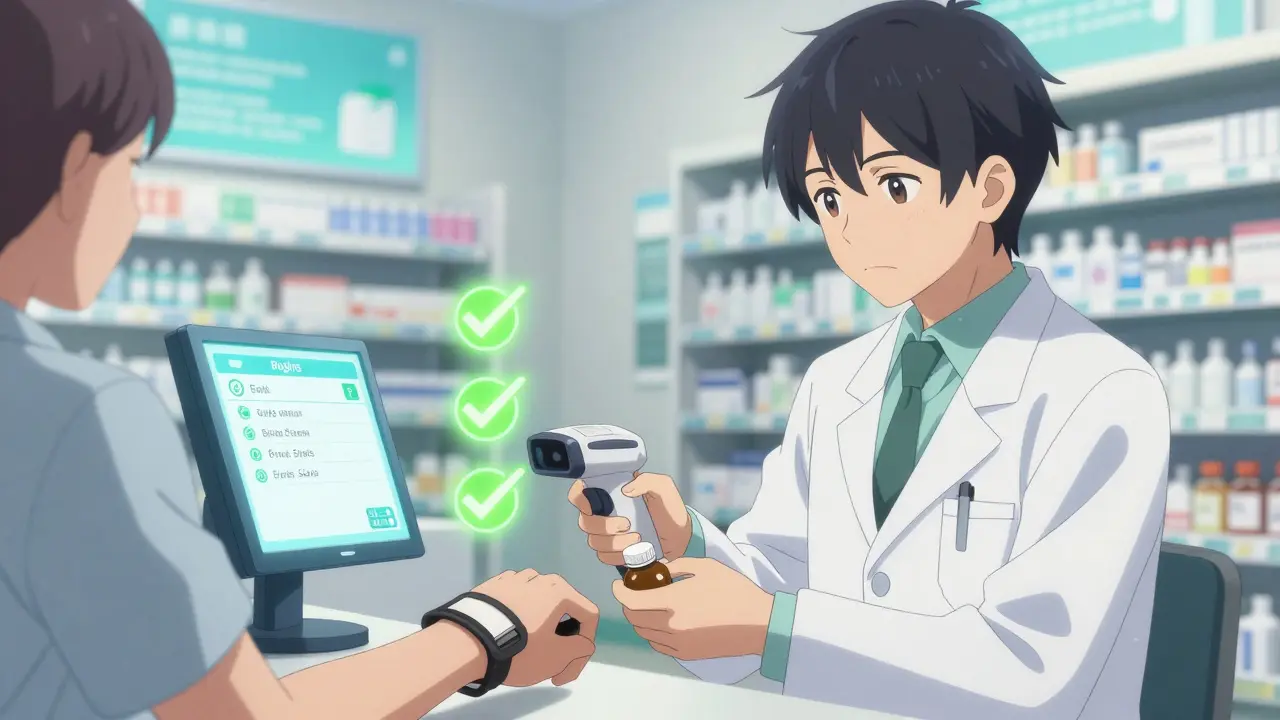
Every year in the U.S., more than 1.3 million medication errors happen because someone picked up the wrong pill, gave the wrong dose, or handed a drug to the wrong patient. Many of these errors are preventable-and barcode scanning in pharmacies is one of the most effective tools doing the job. It’s not magic. It’s simple: scan the patient’s wristband, scan the medication, and let the system check if they match. If they don’t, it stops the process before the error reaches the patient.
How Barcode Scanning Stops Errors Before They Happen
Pharmacies don’t rely on memory or human checks alone anymore. Barcode scanning systems, known as Barcode Medication Administration (BCMA), are built to verify the five rights: right patient, right medication, right dose, right route, and right time. Before a drug is handed over, the pharmacist or technician scans two barcodes: one on the patient’s wristband and one on the medication package. The system instantly compares them against the electronic prescription. If anything’s off-say, the patient is supposed to get 5 mg of lisinopril but the bottle says 10 mg-the system flags it. No scan, no release. This isn’t theoretical. A study from Pennsylvania Hospital showed that before barcode scanning, staff correctly matched medications to patients just 86.5% of the time. After implementing the system, that jumped to 97%. That’s not a small gain-it’s life or death. Wrong doses of blood thinners, insulin, or antibiotics can kill. Barcode scanning catches those mistakes before they leave the pharmacy.The Technology Behind the Scan
Most pharmacy barcodes today are 1D linear codes, like the ones on grocery items. They store the National Drug Code (NDC), a unique 11-digit number assigned by the FDA to every medication. Since 2006, the FDA has required this barcode on all unit-dose packages. But newer systems are moving to 2D matrix codes, which can hold more data-like lot numbers, expiration dates, and even manufacturer info-in a tiny square. By 2026, over 65% of medications are expected to use 2D barcodes, according to the American Society of Health-System Pharmacists. The hardware is simple: handheld scanners, mobile devices with built-in cameras, or fixed stations near dispensing counters. These connect to the pharmacy’s information system (PIS) and the hospital’s electronic health record (EHR) through standard health data protocols. No fancy AI needed-just a reliable scanner and a clean database. But the system only works if the barcode is readable. Damaged, smudged, or poorly printed labels cause 15% of scanning failures, according to ECRI Institute. That’s why staff are trained to visually verify the medication if the scanner won’t read it.Why Manual Checks Don’t Cut It
Before barcode systems, pharmacists relied on double-checking: two people look at the same prescription and bottle. Sounds solid, right? But research shows those manual checks catch only about 36% of errors. People get tired. They’re rushed. They assume the label is right because “it’s always been this way.” Barcode scanning cuts through that. It doesn’t get distracted. It doesn’t misread handwriting. It doesn’t forget to check the dose. A 2021 BMJ Quality & Safety study found BCMA systems prevent 93.4% of potential dispensing errors-nearly triple the effectiveness of human double-checks. It’s especially good at stopping:- Wrong drug: 89% of incidents prevented
- Wrong dose: 86% prevented
- Wrong patient: 92% prevented
Where It Falls Short
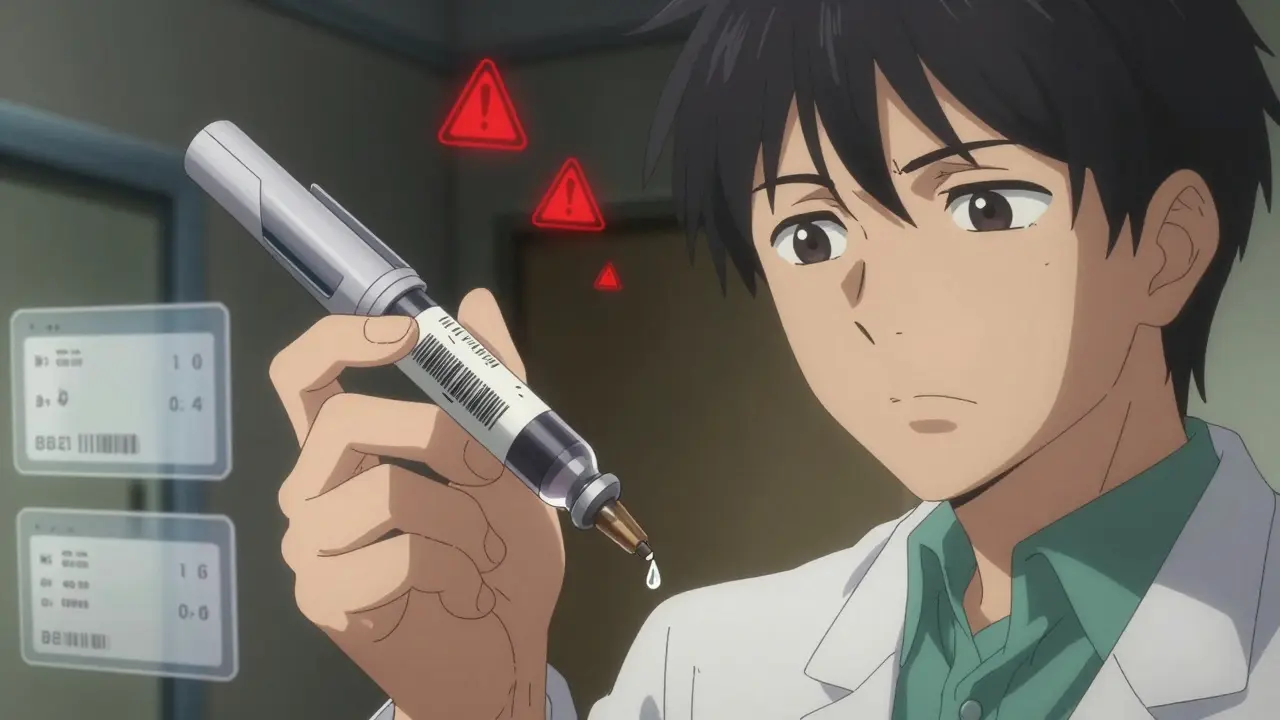
Barcode scanning isn’t perfect. It can’t fix bad labeling. If a pharmacy tech puts the wrong label on a bottle-say, labeling vancomycin as “10 mg/mL” when it’s actually “50 mg/mL”-the scanner will still approve it. The barcode says “vancomycin 50 mg/mL,” and the system believes it. That’s why visual verification is still required. The scanner doesn’t look at the color, the liquid, or the concentration. It reads the code. Other trouble spots include:- Insulin pens and ampules: small, fragile, often lack standard barcodes
- Compounded medications: made in-house, no manufacturer barcode
- Emergency meds: rushed situations where staff skip scans
Workarounds Are the Real Enemy
The biggest threat to barcode safety isn’t the tech-it’s the people. In 68% of hospitals, staff admit to bypassing scans during busy times. Why? Because scanning takes time. A scanner might freeze. A barcode might be unreadable. A nurse might be in a hurry. So they “work around” the system: they scan a different patient’s wristband, they scan a similar-looking bottle, they just click “confirm” without scanning at all. These shortcuts are dangerous. A 2023 Pharmacy Times survey found 41% of pharmacists admitted to occasionally skipping scans during emergencies. That’s a ticking time bomb. The system only works if everyone uses it. That’s why training matters-not just on how to scan, but on why skipping it puts lives at risk.Community Pharmacies Are Lagging Behind
While 78% of U.S. hospitals use barcode scanning, only about 35% of independent community pharmacies do. Why? Cost. Setting up a full BCMA system-scanners, software, integration, staff training-can cost tens of thousands of dollars. For a small pharmacy, that’s hard to justify when they’re already stretched thin. But the savings are real. A single medication error can cost a pharmacy over $100,000 in lawsuits, fines, and lost trust. One study showed that for every dollar spent on BCMA, pharmacies saved $3.50 in error-related costs. The technology pays for itself. And with new mobile-integrated scanners and lower-cost software options, adoption is slowly rising.
What’s Next for Pharmacy Scanning
The future is smarter, not just faster. Epic Systems released a new mobile BCMA tool in March 2024 that improved scanning success by 22% by using phone cameras instead of separate scanners. Cerner is testing AI that predicts when a barcode will fail and suggests better angles before the scan even happens. The FDA is piloting 2D barcodes that include expiration dates and lot numbers directly in the code, so no extra label is needed. Eventually, barcode scanning will merge with RFID and blockchain for full drug traceability-from manufacturer to patient. But for now, the barcode remains the most proven, affordable, and widely adopted tool we have.What Pharmacists Say
Real users have mixed feelings. Sarah Chen, a hospital pharmacist, says: “BCMA cut our errors by 75%. But scanning insulin pens? We need special trays and perfect lighting. It’s a pain.” On Reddit, a pharmacy tech wrote: “It adds 15-20 minutes to every shift. When 10 vials won’t scan, you start cutting corners.” But the wins are undeniable. One tech on LinkedIn shared: “BCMA caught a 10x overdose of levothyroxine last month. That patient is alive because the system said no.” The pattern is clear: when the system works right, it saves lives. When it’s poorly managed, it becomes a burden. The difference? Training, support, and discipline.Best Practices for Getting It Right
If you’re in a pharmacy using barcode scanning, here’s how to make it work:- Always scan the manufacturer’s barcode, not the pharmacy’s label. It’s more reliable.
- Train staff to never bypass a scan-even under pressure.
- Use special trays for small items like ampules and insulin pens.
- Review scanning failure logs weekly. If the same drug keeps failing, report it to the supplier.
- When a barcode won’t scan, stop. Look at the drug. Compare it to the order. Don’t guess.
Do all medications have barcodes?
Since 2006, the FDA has required barcodes with the National Drug Code (NDC) on all unit-dose packages of prescription medications in hospitals and most retail pharmacies. However, some items like compounded drugs, emergency kits, and certain small vials (like insulin pens or ampules) may not have standard barcodes. In those cases, visual verification by a pharmacist is required.
Can barcode scanning prevent all medication errors?
No. Barcode scanning prevents errors related to wrong medication, dose, patient, or timing-but it can’t catch errors where the label itself is wrong. For example, if a pharmacy mislabels a vial of vancomycin with the wrong concentration, the scanner will still approve it because the barcode matches the label. That’s why visual checks are still mandatory. Barcode scanning is one layer in a safety system, not the whole system.
Why do some pharmacists skip scanning?
Staff sometimes skip scans because the system is slow, scanners malfunction, or they’re under pressure during busy times. In emergencies, the urgency to get medication to a patient can override safety steps. But research shows that skipping scans increases error rates dramatically. Training, better equipment, and leadership support are key to reducing these workarounds.
Is barcode scanning used in retail pharmacies?
Yes, but adoption is lower than in hospitals. About 35% of independent community pharmacies use barcode scanning, compared to 78% of U.S. hospitals. The main barriers are cost and workflow disruption. However, as prices drop and systems become easier to integrate, more retail pharmacies are adopting the technology to reduce errors and liability.
What’s the difference between 1D and 2D barcodes in pharmacies?
1D barcodes are the traditional black-and-white lines that store only the NDC number. 2D barcodes are square or rectangular and can hold much more data-like lot number, expiration date, and manufacturer info-in a single scan. 2D codes are more reliable and reduce the need for multiple scans. By 2026, over 65% of medications are expected to use 2D barcodes, according to ASHP.






Neil Ellis
January 22, 2026 AT 11:05 AMBarcodes in pharmacies? Man, it’s like the system finally grew a spine. I used to work ER triage, and I’ve seen the aftermath of a wrong insulin dose - not pretty. This isn’t just tech, it’s dignity. It’s the difference between a patient waking up and a family crying at a funeral. The scanner doesn’t care if you’re tired, rushed, or had a bad night. It just does its job. And honestly? That’s more than I can say for half the humans in the room.
Rob Sims
January 23, 2026 AT 17:32 PMOh wow, look who discovered that machines are better than humans at following instructions. Groundbreaking. Let’s all bow down to our barcode overlords while we sip our artisanal oat milk lattes. Meanwhile, real people are getting fired for ‘bypassing’ a system that freezes every third scan. And yes, I know the stats - I also know that ‘93.4% effective’ sounds great until your cousin gets the wrong drug because someone scanned a different patient’s wristband to save five seconds. This isn’t safety. It’s theater with a printer.
Daphne Mallari - Tolentino
January 25, 2026 AT 13:27 PMWhile the implementation of Barcode Medication Administration (BCMA) systems has demonstrably reduced medication errors by approximately 93% in peer-reviewed studies, one must critically assess the epistemological underpinnings of technological determinism in clinical environments. The reliance on machine-mediated verification, while statistically sound, inadvertently fosters a culture of cognitive offloading - wherein human vigilance, the cornerstone of professional pharmacopeia, is systematically eroded. Furthermore, the commodification of safety through proprietary software ecosystems raises profound ethical concerns regarding vendor lock-in and the depersonalization of care. One cannot help but wonder: are we safeguarding patients… or merely satisfying regulatory checklists?
Tatiana Bandurina
January 25, 2026 AT 23:14 PMLet’s be honest - the real issue isn’t the barcode. It’s the fact that pharmacists are overworked, underpaid, and treated like glorified robots. You want fewer errors? Pay them $50/hour. Give them breaks. Stop scheduling 14-hour shifts. Stop blaming the tech when the system is designed to fail. I’ve seen techs scan a vial three times while holding a crying child in one arm and a phone in the other. That’s not negligence. That’s systemic abuse. The scanner didn’t cause the problem. The hospital did.
Jasmine Bryant
January 26, 2026 AT 08:37 AMi just wanted to add that i work at a small clinic and we got a cheap usb scanner last year - it’s not fancy but it caught a mixup with warfarin and rivaroxaban last month. the bottle labels looked almost identical. i didn’t even notice until the scanner beeped red. also, 2d barcodes are way better for tiny insulin pens - the old 1d ones get smudged so easy. one thing tho - we still have to manually type in lot numbers sometimes because the printer at our supplier keeps messing up the code. maybe someone should tell them to fix it? 🤷♀️
Sarvesh CK
January 27, 2026 AT 11:42 AMIt is a fascinating evolution in healthcare safety, this transition from human intuition to algorithmic verification. In ancient civilizations, healers relied on memory, observation, and tradition; today, we rely on standardized codes and digital cross-referencing. One might argue that this represents a loss of the artisanal quality of care - the personal touch, the seasoned pharmacist’s instinct. Yet, in an era where the volume of prescriptions exceeds human cognitive limits, perhaps this is not a diminishment, but an augmentation. The barcode is not replacing the pharmacist - it is empowering the pharmacist to focus on what machines cannot: empathy, counseling, and complex clinical judgment. Let us not mistake the tool for the healer.
Keith Helm
January 28, 2026 AT 14:35 PMScanning is mandatory. Bypassing is grounds for termination. End of story.
arun mehta
January 30, 2026 AT 13:30 PM👏 This is the kind of post that reminds me why I chose this field. The tech isn’t perfect - no system is - but when it works, it saves lives. I once scanned a vial that looked exactly like levothyroxine… but was actually lithium. The system flagged it. The patient? Still here. The tech? Still scanning. Even when the scanner glitches. Even when the label’s smudged. Even when the nurse is in a rush. We don’t cut corners. We don’t skip. We don’t guess. Because someone’s life isn’t a suggestion - it’s a promise. 💙 #BarcodesSaveLives