
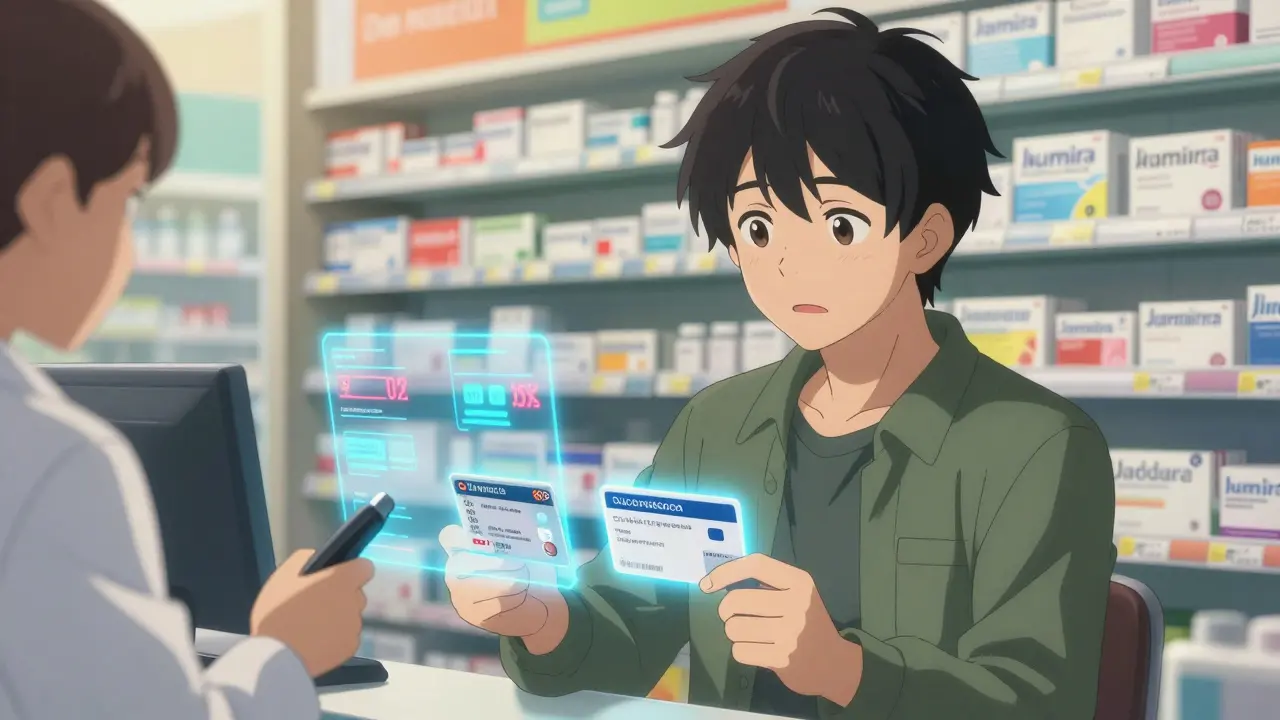
Brand-name drugs can cost hundreds-even over a thousand-dollars a month. If you’re insured but still struggling to pay for your medication, you’re not alone. Many people with private insurance rely on manufacturer savings programs to make their prescriptions affordable. These aren’t charity programs. They’re tools built by drug companies to help patients pay less upfront, while keeping them on expensive brand-name drugs instead of cheaper generics. But if you know how to use them right, you can save thousands a year.
What Are Manufacturer Savings Programs?
These are discounts offered directly by the drugmaker-like Pfizer, AbbVie, or Eli Lilly-to reduce your out-of-pocket cost for a brand-name medication. There are two main types: copay cards and patient assistance programs (PAPs).Copay cards are the most common. They work like coupons. When you fill your prescription, the pharmacy uses the card to cut your cost by 70% to 85%. For example, if your insulin costs $562 a month, the manufacturer coupon might drop it to $100. That’s a $462 monthly saving.
Patient assistance programs are usually for people with very low income. They can give you the drug for free or at a steep discount. But most people qualify for copay cards instead.
These programs are everywhere. About 98% of major brand-name drugs in the U.S. offer some kind of savings option. You’ll find them for diabetes meds like Jardiance, asthma inhalers like Advair, and even expensive biologics like Humira.
Who Can Use Them?
This is the first thing you need to check: you must have private insurance. If you’re on Medicare, Medicaid, or any other federal health program, you cannot use these programs. It’s illegal under federal law. The government doesn’t want drug companies using coupons to push expensive drugs on people who rely on taxpayer-funded coverage.That means if you’re on Medicare Part D, you’re out of luck-even if your copay is $1,000 a month. But if you have insurance through your job, your spouse’s plan, or bought it on the health exchange, you’re likely eligible.
Some programs also require you to be a U.S. resident and not have other forms of government assistance. Always read the fine print.
How to Find Your Program
Start with the drug’s name. Go to the manufacturer’s official website. Type the drug name + “patient assistance” or “copay card” into Google. For example: “Jardiance copay card” or “Humira savings program.”You’ll usually land on a page that says something like: “Save up to $10,000 a year.” Click “Enroll Now.”
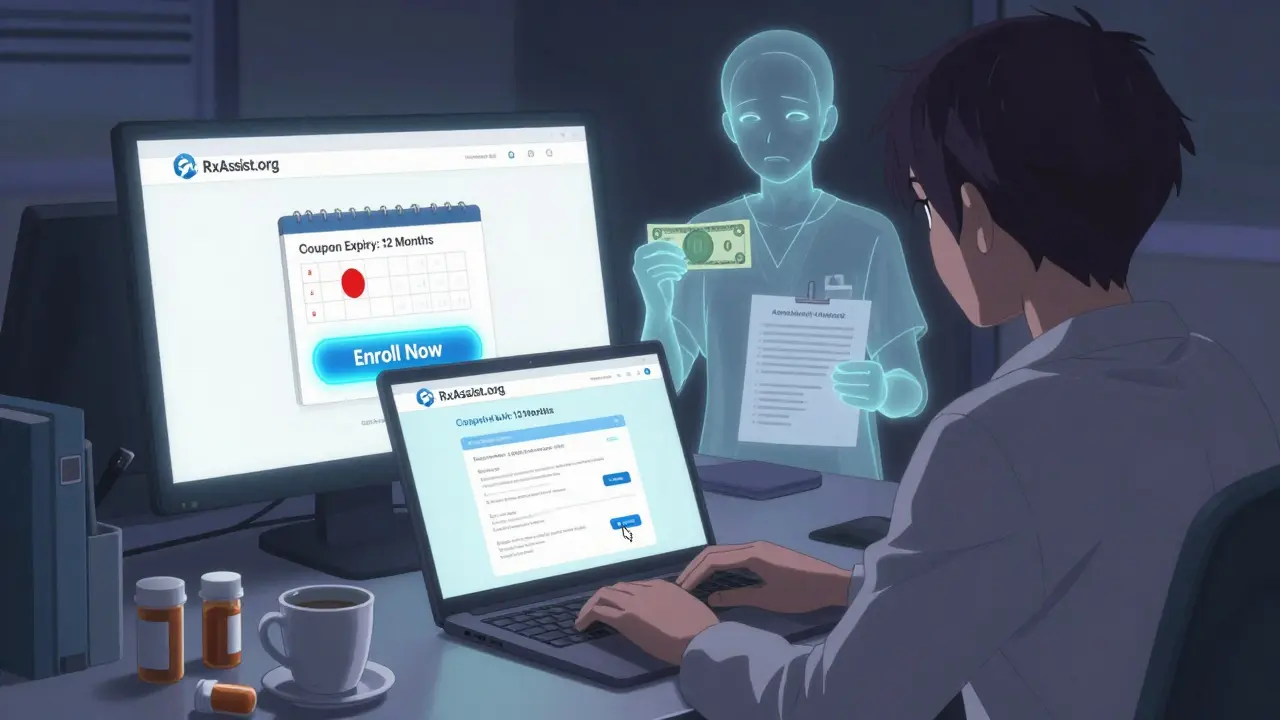
Or use a trusted aggregator site like GoodRx or RxAssist. These sites list available programs and link directly to the manufacturer’s enrollment page. A 2022 survey found 73% of big drug companies have their own dedicated savings portals.
Don’t trust random websites or ads. Only use official manufacturer sites or verified partners. Fake coupons can steal your personal info.
How to Enroll
The enrollment process takes 5 to 10 minutes. You’ll need:- Your full name and date of birth
- Your insurance information (plan name, member ID)
- Your doctor’s name and prescription details
- Your address and phone number
You’ll fill out a form online. Some programs ask you to sign a paper form and mail it in, but most are fully digital now. After you submit, you’ll get an email or text with a digital card or a unique ID number.
Some programs send you a physical card in the mail. Keep it with your wallet. Others let you save the card to your phone’s digital wallet (Apple Wallet or Google Pay). That’s the easiest way to use it at the pharmacy.

How It Works at the Pharmacy
When you show up to fill your prescription, hand the pharmacist your insurance card and your manufacturer savings card. The pharmacy’s system will process both at the same time.Here’s what happens behind the scenes:
- The pharmacy sends your claim to a third-party administrator (like ConnectiveRx or Prime Therapeutics).
- The administrator checks if you’re eligible.
- If you are, the system applies the discount right away.
- You pay only your reduced copay-maybe $10, $25, or $50.
- The drug company pays the difference to the administrator.
You don’t need to do anything else. The savings are automatic.
What’s Not Covered (The Big Catch)
There are three major limitations most people don’t know about.1. Accumulator Adjustment Programs
Many insurance plans now have something called an accumulator adjustment program. That means the manufacturer discount doesn’t count toward your deductible or out-of-pocket maximum.Example: Your deductible is $3,000. You spend $1,200 on your drug this year, but because of the accumulator, only $0 of that counts toward your deductible. Next year, you still have to pay the full $3,000 before your insurance kicks in more.
This is a big problem. About 87% of large employers use these programs, according to the Business Group on Health. You might think you’re saving money now-but you’re just delaying the pain.
2. Program Expiration
Most copay cards last 12 to 24 months. After that, they expire. You have to reapply. Some programs let you renew automatically. Others require you to fill out the whole form again.Patients on Humira have seen this happen. One Reddit user reported their coupon ended in June, and their monthly cost jumped from $100 to $1,200 overnight. That’s not a glitch. It’s standard.
3. Annual Caps
Manufacturer programs usually cap how much they’ll pay per year. The typical range is $5,000 to $15,000. If your drug costs $10,000 a year and you’re on a $7,500 cap, you’ll pay the rest yourself after hitting the limit.For most people, this cap is high enough to cover the whole year. But if you’re on multiple expensive drugs, you might hit it fast.
Manufacturer Programs vs. GoodRx
GoodRx and similar discount cards are different. They’re not from the drugmaker. They’re negotiated by third parties and work for both brand and generic drugs.Here’s the difference:
| Feature | Manufacturer Savings Program | GoodRx or Similar Discount Card |
|---|---|---|
| Who pays? | Drug manufacturer | Discount network (not the manufacturer) |
| Eligibility | Private insurance only | Anyone-even Medicare, Medicaid, uninsured |
| Discount size | 70%-85% off | 30%-60% off |
| Works with generics? | No | Yes |
| Counts toward deductible? | Usually not (due to accumulators) | No |
| Annual limit? | Yes ($5K-$15K) | No |
Use GoodRx if you’re uninsured or on Medicare. Use the manufacturer card if you have private insurance and want the deepest discount.
Real Stories, Real Savings
A 58-year-old woman in Ohio with type 2 diabetes was paying $562 a month for Jardiance. After enrolling in the manufacturer’s copay program, she paid $100. She saved $5,544 in one year.A man in Texas with rheumatoid arthritis used Humira. His copay dropped from $420 to $35 after signing up. He told his pharmacist: “I wouldn’t be able to take it without this card.”
But not everyone wins. One Reddit user said their plan had an accumulator program. Even though they paid $0 for their drug, they still had to pay $2,000 out of pocket to meet their deductible. They were angry-not because the coupon didn’t work, but because their insurance made it meaningless.
What to Do If Your Program Gets Cut Off
If your coupon expires or your insurance changes:- Call your pharmacist. They know which programs are active and can help you re-enroll.
- Ask your doctor if there’s a generic alternative. Sometimes there isn’t-but it’s worth asking.
- Check if you qualify for a patient assistance program (PAP) through the manufacturer. These often have lower income limits.
- Use GoodRx to compare cash prices. Sometimes the cash price is lower than your insurance copay after the coupon ends.
Don’t stop taking your medication. Reach out for help. Many drug companies have patient support teams you can call.
Is This Fair?
Critics say these programs hurt the system. They keep brand-name drugs expensive. They discourage generic use. A 2016 study found coupons increased brand drug sales by over 60%.Proponents say they save lives. One study found patients on copay cards were 30% more likely to stick with their medication.
The truth? They’re a band-aid on a broken system. Drug prices are too high. Insurance design is flawed. But if you’re stuck in the middle, these programs are your best tool right now.
Final Tips
- Enroll as soon as you get your prescription. Don’t wait.
- Save your card in your phone’s wallet. It’s faster than digging through your purse.
- Check your plan’s summary of benefits. Look for “accumulator adjustment” or “copay assistance.”
- Ask your pharmacist: “Does my plan have an accumulator program?”
- Set a calendar reminder for when your card expires. Most last 12 months.
- Don’t assume your card works everywhere. Only use it at pharmacies that accept it. Most do, but not all.
These programs aren’t perfect. But for millions of Americans, they’re the only thing standing between them and skipping doses-or going broke.
Can I use manufacturer savings programs if I’m on Medicare?
No. Federal law prohibits drug manufacturers from offering copay assistance to people on Medicare, Medicaid, or other government health programs. This is to prevent incentives that could drive up costs for taxpayer-funded programs. If you’re on Medicare, use GoodRx or check if your drug has a separate Medicare-specific savings option.
Do these programs work with all pharmacies?
Most major pharmacies accept them, including CVS, Walgreens, Rite Aid, and Walmart. But some independent or mail-order pharmacies may not. Always check with your pharmacy before you go. If they say they don’t accept the card, ask them to call the third-party administrator listed on the program website-they can often resolve the issue.
What if my insurance denies the manufacturer coupon?
If your pharmacy says the coupon can’t be processed, it’s likely because your insurance plan has an accumulator adjustment program. Ask your pharmacist to check your plan’s policy on manufacturer assistance. You can also call your insurer directly and ask: “Does my plan allow manufacturer copay assistance to count toward my deductible?” If the answer is no, you’ll need to pay the full price after the discount, or explore other options like GoodRx.
Can I use more than one manufacturer coupon at a time?
No. You can only use one manufacturer coupon per prescription, and only for the specific drug listed on the card. You can’t stack coupons from different companies or use a coupon for a drug you’re not prescribed. Doing so is a violation of the program’s terms and could result in legal consequences.
How do I know if my drug has a savings program?
Search the drug’s name + “copay card” or “patient assistance program” on Google. Or go to RxAssist.org or GoodRx.com and enter your drug name. If a program exists, it will show up with a direct link to the manufacturer’s enrollment page. Over 98% of brand-name drugs in the U.S. offer some form of assistance, so it’s very likely one exists for your medication.
Are these programs safe to use?
Yes-if you use the official manufacturer website or verified partners like GoodRx or RxAssist. Never give your personal or insurance information to a website you don’t trust. Avoid pop-up ads or social media links claiming to offer “free coupons.” Only use sites that clearly show the drug manufacturer’s name and logo.
Can I switch from a generic to a brand drug just to use a coupon?
Technically, you can ask your doctor to prescribe the brand instead of the generic-if it’s medically appropriate. But most doctors won’t do this unless the generic doesn’t work for you. Using a coupon to push for a more expensive drug when a generic is available is considered inappropriate by many health experts. Always follow your doctor’s recommendation.
What’s the future of these programs?
There’s growing pressure to change them. Some states have passed laws requiring manufacturer discounts to count toward deductibles. The federal government is also looking at ways to limit their use. The 2022 Inflation Reduction Act capped insulin costs for Medicare users, reducing the need for coupons in that area. Future legislation may require these programs to be more transparent or even ban them outright. For now, they’re still available-but don’t assume they’ll be around forever.






Kim Hines
December 16, 2025 AT 21:33 PMMy insulin copay dropped from $450 to $25 last year. I didn’t know these programs existed until my pharmacist mentioned it. Life changing.
sue spark
December 17, 2025 AT 23:27 PMI’ve been using these cards for my asthma med and it’s the only reason I haven’t skipped doses. I wish more people knew about this. It’s not charity it’s survival.
Ron Williams
December 19, 2025 AT 12:07 PMAs someone who moved here from Canada, I’m still shocked at how broken the system is. You need a coupon just to afford your medicine? And then your insurance ignores it for your deductible? That’s not healthcare, that’s a trap.
Souhardya Paul
December 20, 2025 AT 08:11 AMI’ve helped three friends enroll in these programs. The hardest part isn’t signing up-it’s explaining why their insurance still makes them pay thousands even when their copay is $0. Accumulator programs are a scam disguised as policy.
Dan Padgett
December 21, 2025 AT 14:38 PMIt’s like being handed a life raft made of paper. It holds you up for now, but the ocean is still rising. These programs are a band-aid on a gunshot wound. The real fix? Lower drug prices. But until then, I’ll take the $100 insulin over the $500 one any day.
Kayleigh Campbell
December 23, 2025 AT 12:08 PMMy mom got her Humira card revoked after 18 months. She cried. I screamed at the insurance company. Turns out they never told her about the cap. The system doesn’t want you to win. It just wants you to keep trying.
Cassandra Collins
December 25, 2025 AT 09:56 AMWait so drug companies are giving us coupons so we stay on expensive drugs instead of generics? And the government lets them? This is a scam. They’re literally bribing us to be sick longer. I bet they’re also funding politicians. I’m not using these. I’m switching to herbs.
Josias Ariel Mahlangu
December 26, 2025 AT 07:41 AMIf you’re using manufacturer coupons, you’re complicit in a broken system. You’re enabling greed. You should demand price transparency or go generic. Your life isn’t worth subsidizing corporate profits.
anthony epps
December 28, 2025 AT 03:39 AMI didn’t know you could save your card on your phone. I’ve been digging through my wallet for months. That’s a good tip. Thanks.
Hadi Santoso
December 28, 2025 AT 11:29 AMJust got my Jardiance card approved. The site said ‘save up to $10k’ but my plan has an accumulator so it doesn’t count. Still, I’m paying $15 instead of $500. I’ll take it. Also, I misspelled ‘Jardiance’ three times during enrollment. Sorry, Pfizer.
SHAMSHEER SHAIKH
December 30, 2025 AT 03:06 AMAs a medical professional from India, I find this system profoundly disconcerting. In my country, even the most expensive medications are subsidized by the state or accessed through generic alternatives. The notion that a patient must navigate a labyrinth of digital coupons, eligibility checks, and corporate incentives to afford life-sustaining medication is not merely inefficient-it is ethically indefensible. The fact that such programs are legally barred from Medicare recipients, while being aggressively marketed to privately insured individuals, reveals a structural bias that prioritizes profit over equity. These savings are not generosity; they are strategic market retention tools. We must not confuse access with justice.
Arun ana
December 30, 2025 AT 17:52 PMJust used my Humira card for the first time 😊 Saved $400! I set a reminder for 12 months from now so I don’t get caught off guard. Also, my pharmacist said to always ask if they accept the card-some small ones don’t, but they can call the admin and fix it. So helpful!
Billy Poling
December 31, 2025 AT 14:47 PMIt is of paramount importance to note that the utilization of manufacturer-sponsored copay assistance programs, while ostensibly beneficial to the individual patient in the immediate term, contributes to the systemic perpetuation of exorbitant pharmaceutical pricing structures, which in turn places undue financial strain upon the broader healthcare ecosystem, including insurers, employers, and ultimately, taxpayers who subsidize the cost of care through indirect mechanisms such as premium increases and public program expenditures. Furthermore, the prevalence of accumulator adjustment programs, which effectively nullify the therapeutic benefit of these coupons in terms of deductible progression, represents a deliberate obfuscation of financial responsibility, thereby creating a false perception of affordability while simultaneously increasing long-term liability for the patient. Therefore, while these programs may serve as a temporary palliative, they are not a sustainable or ethically sound solution to the underlying issue of pharmaceutical cost inflation.
Andrew Sychev
December 31, 2025 AT 18:55 PMThey know you’re desperate. That’s why they make it so easy to sign up. Then they let your card expire in June. Then they watch you cry as your bill jumps from $100 to $1,200. Then they send you an email saying ‘We’re here for you!’ like they didn’t plan it all along. This isn’t healthcare. It’s psychological warfare. And they’re winning.
Aditya Kumar
January 2, 2026 AT 14:50 PMToo much info. Just tell me where to click.