
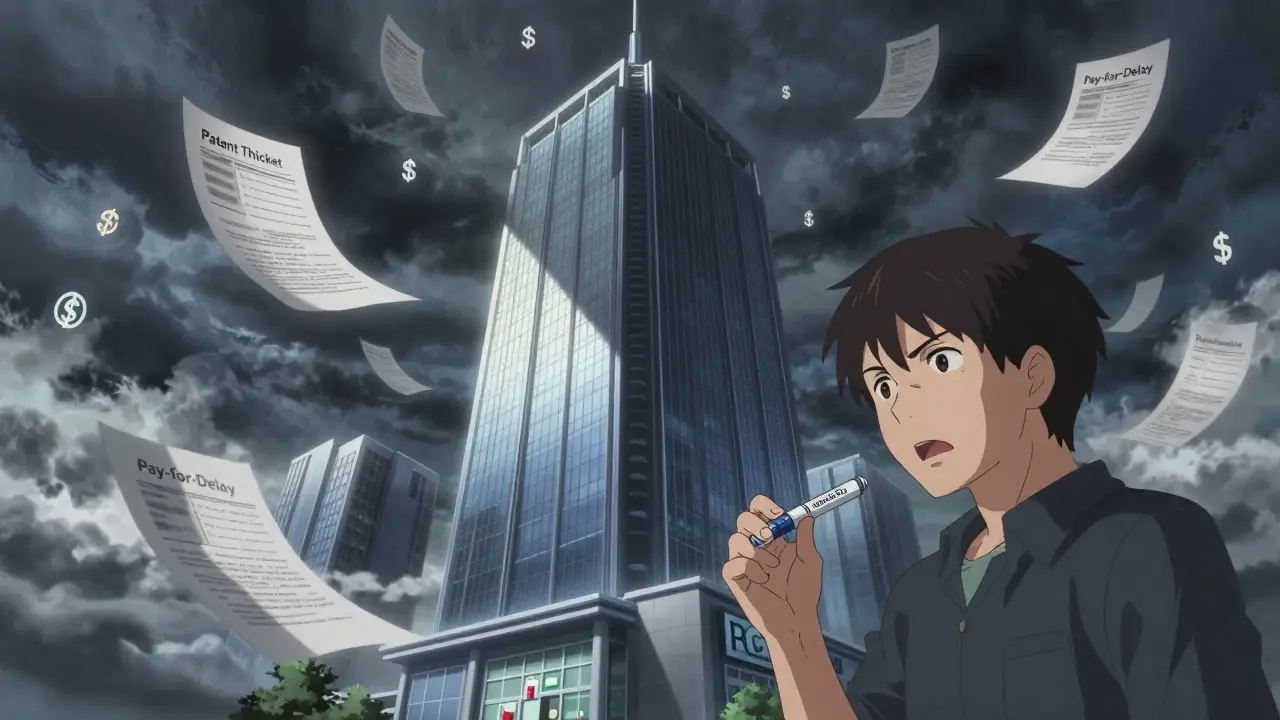
Ever wonder why some prescription drugs cost hundreds or even thousands of dollars a month, while others are available for under $10? It’s not because one is better than the other. It’s because brand-name drugs without generic alternatives are protected by layers of legal and technical barriers designed to keep competition out - even after the original patent runs out.
Patents Aren’t the Whole Story
Most people think that once a drug’s 20-year patent expires, generics automatically flood the market. That’s not true. While patents are the first line of defense, they’re just the beginning. Companies don’t just rely on one patent. They file dozens - covering everything from the chemical structure to the shape of the pill, the coating, the delivery system, even the way it’s manufactured. This is called a "patent thicket." For example, the asthma drug Advair Diskus had over 40 patents covering different parts of its design. Even after the main patent expired, generic makers couldn’t get approval because they couldn’t legally copy all those protected features without facing lawsuits.Complex Drugs Can’t Be Copied Easily
Not all drugs are made the same. Some are simple chemicals you can mix in a lab. Others are biological - made from living cells, like antibodies or proteins. These are called biologics. Drugs like Humira (for rheumatoid arthritis) and Enbrel (for psoriasis) fall into this category. You can’t just recreate them like you would aspirin. They’re too complex. That’s why the FDA created a separate approval path called "biosimilars," but it’s not the same as a generic. Biosimilars require years of clinical testing, cost millions to develop, and still can’t be labeled as "generic." The first biosimilar for Humira didn’t hit the U.S. market until 2023 - seven years after its patent expired. Meanwhile, the brand version still sold for over $70,000 a year.Some Drugs Just Can’t Be Replicated
Then there are drugs like Premarin, a hormone therapy for menopause. Its active ingredients come from the urine of pregnant horses. There are dozens of different estrogen compounds in it - many of which aren’t even fully identified. No lab can perfectly recreate that mix. So even though Premarin’s patent expired decades ago, there’s still no true generic. Generic manufacturers can make something similar, but the FDA won’t approve it as "therapeutically equivalent" because they can’t prove it works the same way. Patients who switch often report different side effects or reduced effectiveness - even if the label says "same active ingredient."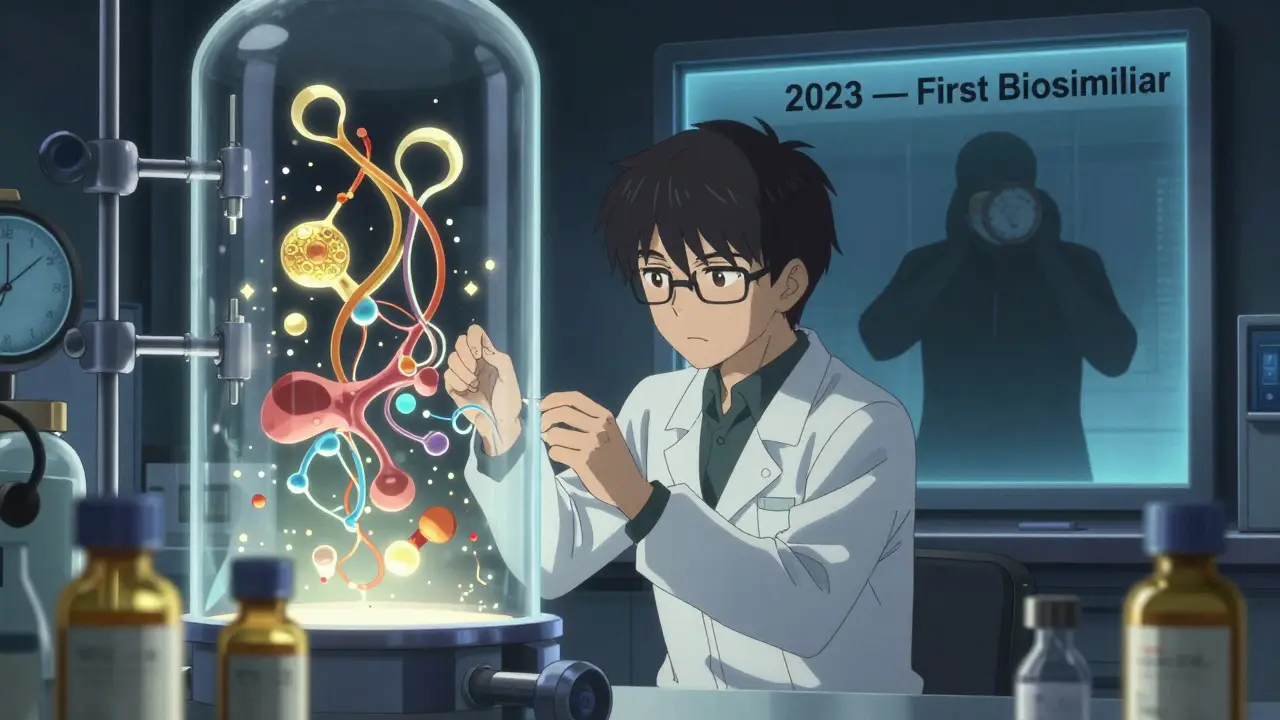
Manufacturing Is a Hidden Hurdle
Even if a drug is chemically simple, making a generic version isn’t always straightforward. Take extended-release pills like Prozac Weekly. The drug has to release slowly over days. That requires special coatings, tiny pellets, or complex matrices. Change the inactive ingredients - the fillers, binders, or coatings - even slightly, and the drug might release too fast or too slow. The FDA requires generic makers to prove their version behaves exactly like the brand in the body. For these complex formulations, that can take years of testing. The same goes for inhalers, patches, and injectables. The delivery system is often patented separately. So even if the active ingredient is free to copy, the way it’s delivered isn’t.Patent Extensions and "Product Hopping"
Pharmaceutical companies don’t wait for patents to expire. They actively extend them. One common trick is called "product hopping." Just before a patent runs out, the company releases a slightly modified version - maybe a new pill shape, a new dosage form, or a new delivery device. They then market it as "improved" and stop making the old version. This forces patients and doctors to switch. The new version gets a fresh patent clock. AstraZeneca did this with Nexium. When the patent for Prilosec (omeprazole) was about to expire, they launched Nexium (esomeprazole), which was just one enantiomer of the same molecule. It wasn’t more effective, but it got a new 20-year patent. That delayed generics for over a decade.Pay-for-Delay Deals
Sometimes, the brand-name company doesn’t fight the generic. They pay it to stay away. These are called "pay-for-delay" settlements. The brand pays the generic manufacturer millions to delay launching its cheaper version. The Federal Trade Commission found 297 of these deals between 1999 and 2012. They cost consumers over $3.5 billion a year. One example: when the patent for the antidepressant Wellbutrin XL was set to expire, the maker paid a generic company $100 million to hold off for 18 months. During that time, the brand sold over $1 billion worth of pills at full price.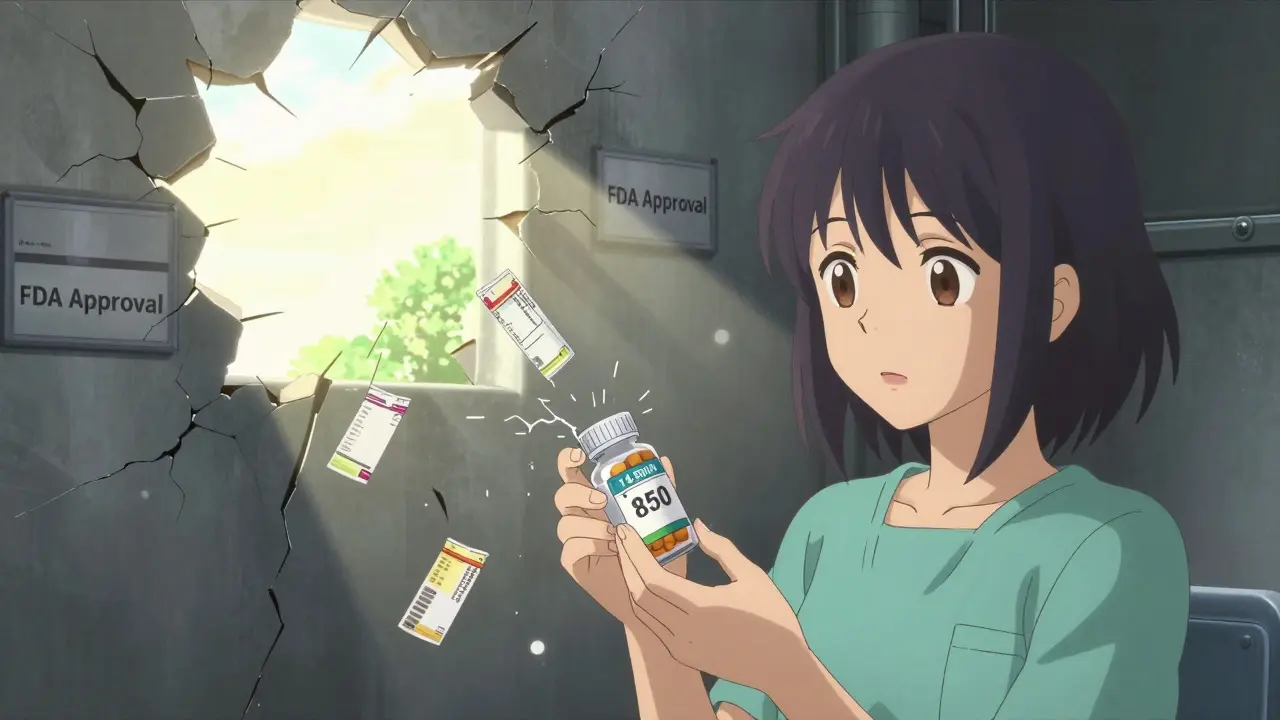
Why This Matters for Patients
The cost difference isn’t small. A 2022 GoodRx analysis found that brand-name drugs without generics cost, on average, 437% more than their generic equivalents. Take EpiPen. Even after its patents expired, Mylan kept raising the price - from $100 to over $600 for two pens - because no generic could get approved fast enough. Patients with chronic conditions like epilepsy, thyroid disease, or cancer often pay $10,000 to $15,000 a year for brand-name drugs. When generics finally arrive, prices drop 80% to 85%. One patient on Reddit shared that after Gleevec (a leukemia drug) went generic, their monthly cost fell from $14,500 to $850. That’s not a savings. That’s life-changing.What’s Changing Now?
There’s pressure to fix this. The CREATES Act of 2019 stopped brand companies from blocking generic makers from getting samples of their drugs - a tactic used to delay testing. The FDA has also sped up reviews of complex generics, approving 27% more in 2022 than in 2021. Biosimilar approvals are rising fast - from 32 in 2022 to an expected 75 by 2025. But even with these changes, some drugs will never have true generics. Insulin formulations, rare disease treatments, and ultra-complex biologics are likely to stay expensive for years. Experts estimate that by 2030, about 5% of all prescription drugs will still have no affordable alternative - not because they’re too hard to make, but because the system lets companies keep them that way.What Can You Do?
If you’re paying a lot for a brand-name drug, ask your doctor or pharmacist: Is there a generic? Is there a similar drug that’s cheaper? Sometimes, switching to a different medication in the same class - like going from Viibryd to sertraline for depression - can save hundreds without losing effectiveness. Check the FDA’s Orange Book to see what patents are still active. And if you’re on Medicare Part D, your plan may have a formulary that pushes you toward cheaper options. Don’t assume you’re stuck with the price tag. The system is stacked, but you’re not powerless.Why can’t generic companies just copy brand-name drugs once the patent expires?
They can - but only if the drug is simple enough to replicate exactly. Many drugs have complex formulations, delivery systems, or biological components that can’t be copied with standard methods. Even small changes in inactive ingredients can affect how the drug works. The FDA requires generics to prove they’re bioequivalent, which takes time and money. Some companies also use legal tactics like patent thickets or pay-for-delay deals to block generics from entering the market.
Are generics as safe and effective as brand-name drugs?
Yes - for most drugs. The FDA requires generics to contain the same active ingredient, strength, dosage form, and route of administration as the brand. They must also prove they’re absorbed into the body at the same rate and extent. Over 90% of prescriptions in the U.S. are filled with generics because they’re proven to work the same. But for drugs with narrow therapeutic windows - like warfarin, thyroid meds, or seizure drugs - some patients report differences. That’s rare, but it happens. Always talk to your doctor before switching.
What’s the difference between a generic and a biosimilar?
Generics are exact copies of small-molecule drugs made with chemicals. Biosimilars are highly similar versions of biologic drugs - which are made from living cells. You can’t copy a biologic exactly, so biosimilars aren’t identical. They’re designed to have no clinically meaningful differences in safety or effectiveness. But they require more testing and cost more to develop. Biosimilars also can’t be labeled as "generics" under U.S. law.
How do I find out if a drug has a generic version?
Check the FDA’s Orange Book online - it lists all approved drugs and their patent and exclusivity status. You can also ask your pharmacist or use tools like GoodRx, which shows price comparisons between brand and generic versions. If the drug is listed as "AB-rated" in the Orange Book, it means the FDA considers it therapeutically equivalent to the brand.
Why do some drugs stay expensive for decades after their patent expires?
Because companies use legal and regulatory loopholes to extend exclusivity. These include filing multiple patents, making minor changes to the drug (product hopping), paying competitors to delay generics (pay-for-delay), and blocking access to samples needed for testing. Complex drugs like biologics or those with specialized delivery systems also face longer approval times. All of this adds up to years - sometimes over a decade - where the brand has no real competition.





Kaylee Esdale
December 17, 2025 AT 01:52 AMGeneric drugs work fine for most people. But when your life depends on it, you don’t want to gamble. I’ve seen people switch and crash. It’s not fear-it’s experience.
Not every drug is a pill you can crush and split.
Some things just can’t be copied.
And that’s okay.
We need better systems, not just cheaper options.
Nishant Desae
December 17, 2025 AT 02:44 AMyou know i was reading this and it made me think about my uncle in india who takes medicine for diabetes and he pays like 200 rupees for a month supply but here in usa same thing costs like 500 dollars and its not even the same company like how is that fair? i mean the science is the same right? why does the price change based on where you live? i think its wrong and its not about the drug its about the system and people are suffering because of it and i just wish we could fix it i know its hard but its not impossible
Martin Spedding
December 17, 2025 AT 23:52 PMPatent thicket? More like corporate extortion.
And pay-for-delay? That’s not capitalism. That’s bribery with a pharmacy label.
They’re not innovating. They’re just playing monopoly with your life.
Raven C
December 18, 2025 AT 01:38 AMLet’s be honest: the entire pharmaceutical industry is a grotesque theater of greed wrapped in white coats and FDA jargon.
They don’t cure diseases-they monetize dependency.
And we, the public, are the unwitting patrons paying for front-row seats to the spectacle.
Every time someone says, ‘But innovation needs protection,’ I want to scream into a void.
There’s nothing innovative about extending a patent by changing the pill’s color.
It’s theatrical sabotage dressed as science.
And the FDA? Complicit.
They approve biosimilars with the enthusiasm of a bureaucrat filling out tax forms.
Meanwhile, patients are rationing insulin.
And we call this a healthcare system?
It’s a casino where the house always wins-and the players die slowly.
Kent Peterson
December 19, 2025 AT 11:01 AMOh please. You’re blaming Big Pharma, but you ignore the fact that generics are often made in countries with zero quality control.
That’s why the FDA is slow-because they’re not trying to protect profits, they’re trying to stop people from dying from counterfeit meds.
And don’t even get me started on how India exports cheap drugs that kill Americans who buy them online.
It’s not a conspiracy-it’s common sense.
Also, ‘product hopping’? That’s called progress.
Would you rather use a 1998 version of a drug just because it’s cheaper?
Of course not.
So stop pretending this is about greed and not safety.
Donna Packard
December 19, 2025 AT 21:10 PMI just want to say thank you for writing this.
My mom was on Humira for years.
When the biosimilar finally came, her co-pay dropped from $800 to $40.
She cried.
Not because she was sad.
Because she could finally breathe again.
And that’s what matters.
Sachin Bhorde
December 21, 2025 AT 04:41 AMbro the real issue is not patents its the supply chain chaos.
like yes the pharma co. holds patents but the real bottleneck is the API manufacturers in china and india who dont have capacity.
also the FDA takes 3 years to approve a generic because they dont have enough inspectors.
and dont even get me started on the lack of skilled chemists in usa.
so its not just greed its infrastructure failure.
we need to invest in local manufacturing not just rant about big pharma.
also biosimilars are not generics they are like a high res scan of a painting vs a photocopy.
its not the same thing.
and yes i know what i'm talking about i work in med logistics.
Evelyn Vélez Mejía
December 23, 2025 AT 01:45 AMThere exists within this system a profound moral inversion: we celebrate the inventor of the pill, yet we silence the voice of the patient who must swallow it.
Patents were never meant to be perpetual monopolies disguised as innovation-they were intended as temporary incentives, a social contract between society and the scientist.
But now, the contract has been rewritten by lobbyists, not legislators.
The language of science has been co-opted by the lexicon of litigation.
And in this new lexicon, ‘bioequivalence’ is a euphemism for ‘we can’t prove it’s the same, but we’ll make you take it anyway.’
What is a life worth when it is measured not in years, but in co-pays?
When the difference between survival and surrender is determined by a spreadsheet and not a stethoscope?
Perhaps the most dangerous patent of all is the one we’ve granted to indifference.
We have forgotten that medicine, at its core, is not commerce-it is care.
And care, when commodified, becomes cruelty.
Let us not mistake the machinery of profit for the morality of healing.
BETH VON KAUFFMANN
December 24, 2025 AT 03:29 AMLet’s cut through the noise. The real problem isn’t patents-it’s the FDA’s archaic approval process for complex generics.
They’re still using 1980s bioequivalence models for 2020s nanoparticle delivery systems.
And biosimilars? A bureaucratic nightmare. You need 10,000 patients in Phase III trials for a biologic? That’s not science-it’s a financial blockade.
Meanwhile, the EU approves biosimilars in half the time.
So stop blaming pharma-blame the regulators who refuse to modernize.
And don’t even get me started on the ‘therapeutic equivalence’ myth.
It’s a legal fiction designed to make patients feel safe while the real variables-bioavailability, excipients, dissolution profiles-are buried in 500-page dossiers no one reads.
This isn’t a drug crisis.
This is a regulatory failure dressed in white coats.
Josh Potter
December 25, 2025 AT 17:18 PMyo i just got my gleevec generic last month and my bill went from 14k to 800
bro i almost cried in the pharmacy
like this isnt a savings its a second chance
and now my insurance is happy too
so yeah the system is rigged but guess what
it can be beat
ask your doc
check goodrx
and dont let them tell you its hopeless
you got power
you just gotta use it
Jessica Salgado
December 26, 2025 AT 14:40 PMI used to think generics were just cheaper versions of the same thing.
Then my sister switched from brand-name Lamictal to generic-and had a seizure.
She didn’t die.
But she almost did.
And the doctor said, ‘It’s bioequivalent.’
But bioequivalent doesn’t mean ‘identical in effect.’
It means ‘close enough for the FDA.’
And that’s terrifying.
Because when your brain is the battlefield, ‘close enough’ isn’t enough.
So yes, most generics are fine.
But not all.
And the system doesn’t tell you which ones are dangerous.
That’s not transparency.
That’s a gamble with your nervous system.
Joe Bartlett
December 26, 2025 AT 15:07 PMLook, I get it. Pharma’s greedy.
But we’ve got the best drug system in the world.
Yes, it’s expensive.
But it’s also the safest.
Other countries get cheap drugs?
They get knockoffs.
And guess what? Their people die from bad batches.
We don’t.
So if you want cheap, go to India.
But don’t complain when your meds don’t work.
And stop acting like the US is the villain.
We fund 70% of global drug R&D.
So yeah, we pay more.
But we also save more lives.
It’s not perfect.
But it’s the best we’ve got.
Marie Mee
December 28, 2025 AT 05:04 AMthey’re hiding something
you think its about patents
but its not
the government and big pharma are in cahoots
they’re putting tracking chips in the pills
and the generics don’t have them
that’s why they won’t approve them
you think your insulin is helping you
but its actually feeding data to the feds
and the brand names? they’re the only ones with the real tech
they control the supply
and they control your body
you think this is about money
but its about control
they dont want you to be free
they want you dependent
on their pills
on their system
on their lies
Salome Perez
December 29, 2025 AT 00:46 AMIn many cultures, medicine is not just a molecule-it is a ritual, a trust, a story passed from healer to patient.
In the U.S., we’ve reduced it to a barcode and a co-pay.
But for many immigrant families-my own included-the brand name is not a corporate logo.
It’s the name their grandmother trusted.
It’s the name that kept their child alive.
And when that name disappears, replaced by a generic they’ve never heard of, the fear is not about efficacy.
It’s about loss.
Loss of memory.
Loss of safety.
Loss of identity.
So when we talk about ‘affordable access,’ we must also talk about cultural continuity.
Because sometimes, healing is not in the chemistry.
It’s in the name on the bottle.
Patrick A. Ck. Trip
December 29, 2025 AT 01:18 AMIt’s worth noting that the CREATES Act, while well-intentioned, has had limited impact because enforcement is weak and penalties for blocking samples are nominal.
Meanwhile, the FDA’s Generic Drug Program remains chronically underfunded, with fewer than 1,000 inspectors overseeing thousands of global manufacturing sites.
And yet, we demand faster approvals.
Ironically, the same stakeholders who demand lower prices are the ones who oppose the increased taxation needed to fund proper oversight.
So the cycle continues: demand more, pay less, get less safety.
It’s not a conspiracy.
It’s human nature.
And it’s why we need structural reform-not just outrage.
Kent Peterson
December 30, 2025 AT 09:32 AMYou say generics saved your life?
Great.
But you also said your sister had a seizure after switching.
So which is it?
Are generics safe?
Or are they dangerous?
You can’t have it both ways.
And that’s the problem.
This isn’t black and white.
It’s messy.
And that’s why we need science-not slogans.
Stop turning medicine into a moral crusade.
Start demanding better data.
And stop blaming corporations for a system you refuse to fix.