
When you're breastfeeding and need to take a short-term medication-whether it's an antibiotic, pain reliever, or something for a cold-it’s natural to worry about your milk. Should you stop nursing? Should you throw out your milk? The truth is, for almost every medication, you don’t have to do either. But you do need to store and label your milk correctly to keep your baby safe and avoid wasting precious milk.
More than 98% of medications are safe to take while breastfeeding. That means you can keep nursing. What changes isn’t whether you feed, but how you manage the milk you pump during the time the medicine is in your system. The goal isn’t to stop breastfeeding-it’s to keep feeding safely.
Why Labeling Matters More Than You Think
Labeling your breast milk isn’t just a good idea-it’s critical when you’re on medication. A simple date and time aren’t enough anymore. You need to know exactly which milk was pumped before, during, and after your dose.
Think of it like this: your body processes medicine in waves. There’s a peak concentration in your milk a few hours after you take it. That milk might be safe to use later, but not right away. If you mix it with milk from another time, you could accidentally feed your baby milk with higher levels of the drug.
Here’s what every container should say:
- Date and time expressed (standard)
- Baby’s name (especially if stored at daycare or with a caregiver)
- Medication name (e.g., “Amoxicillin 500mg”)
- Time taken (e.g., “Taken at 8 AM”)
- Batch number (optional but helpful-e.g., “Batch 1: Pre-med”)
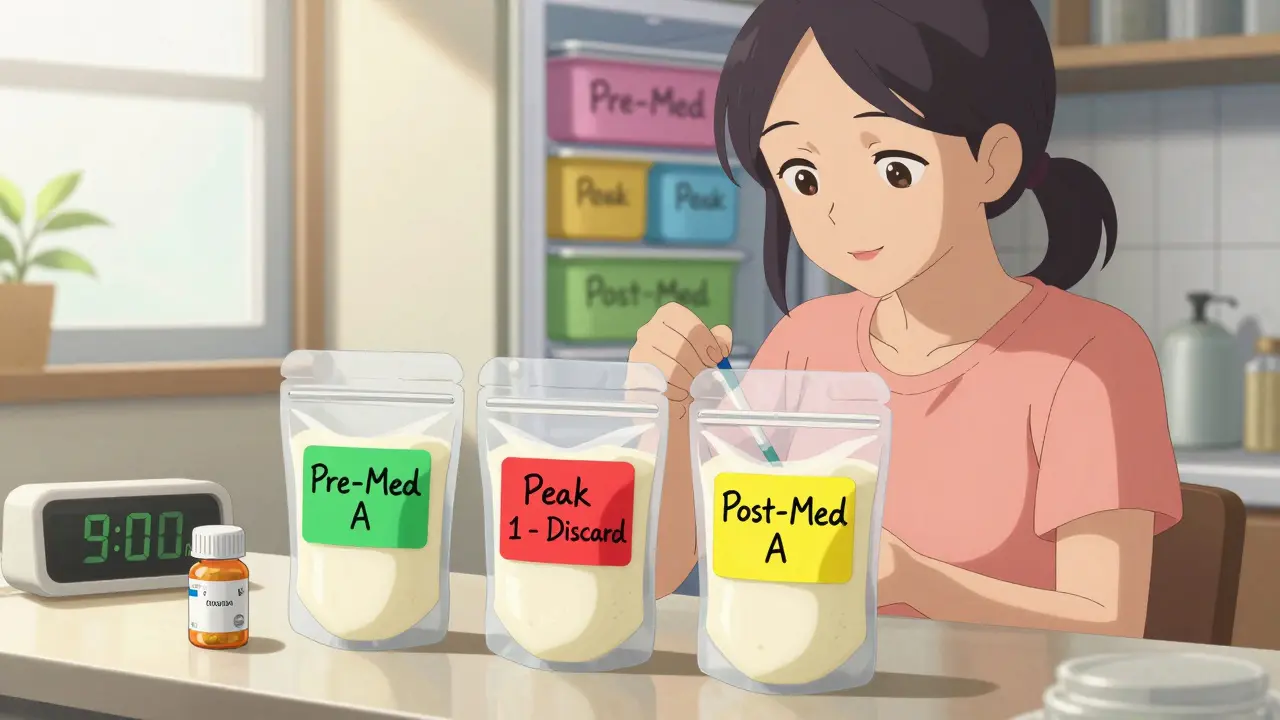
Use waterproof labels and permanent ink. A sticky note or crayon won’t hold up in the fridge or freezer. Many parents now use colored stickers: green for pre-med milk, yellow for peak time, and red for post-med. It’s simple, visual, and reduces mistakes.
Storage Rules: The Standard “Rule of 4s” (and When to Break It)
Normally, breast milk can be stored:
- At room temperature (up to 77°F / 25°C): 4 hours
- In the fridge: up to 4 days
- In the freezer: 6-12 months
These are called the “rule of 4s.” But when you’re on medication, you might need to break them-carefully.
For most drugs, you can still use the standard storage times. But you must separate milk by timing. For example:
- Before your dose: Pump and store this milk normally. It’s safe to use anytime.
- During peak concentration: This usually happens 1-3 hours after taking the pill. Pump this milk separately. Label it clearly. You may need to discard this batch if your provider advises it.
- After the peak: Once the drug has cleared (usually 4-8 hours later), you can pump again and store it as normal.
For short-acting meds like ibuprofen or amoxicillin, you might only need one “discard” batch. For longer-acting drugs, you might need to separate 3-5 batches. The key is to know your medication’s half-life. If you’re unsure, check with your doctor or use a trusted app like MotherToBaby (updated 2024), which gives you personalized timing.
When Do You Actually Need to “Pump and Dump”?
Let’s clear this up once and for all: “Pump and dump” is rarely needed.
Less than 2% of medications require you to throw away milk. Most of those are rare, like chemotherapy drugs or radioactive compounds used in imaging. Even then, the interruption is usually short-often just one or two feedings.
Many mothers panic and dump milk after taking a single painkiller. That’s unnecessary. Studies show that 63% of mothers who took common meds like Tylenol or antibiotics threw away milk they didn’t need to. Why? Because they didn’t have clear guidance.
Here’s what you should do instead:
- Check your medication’s safety rating. Use the Lactation Network’s database or the Hale Medications and Mothers’ Milk scale. L1 (safest) to L2 (probably safe) drugs rarely require discarding milk.
- If your provider says to dump, ask: “For how long?” They should be able to tell you the exact window.
- Never dump more than necessary. Milk is valuable. Your body works hard to make it.
How to Store Separated Batches Without Confusion
Managing multiple batches sounds messy-but it doesn’t have to be.
Use small containers. Store milk in 2-4 ounce portions. That way, if you need to discard one batch, you’re not wasting a whole gallon. Freezers work best when you don’t overfill. Milk expands as it freezes, so leave an inch of space at the top.
Organize your freezer like this:
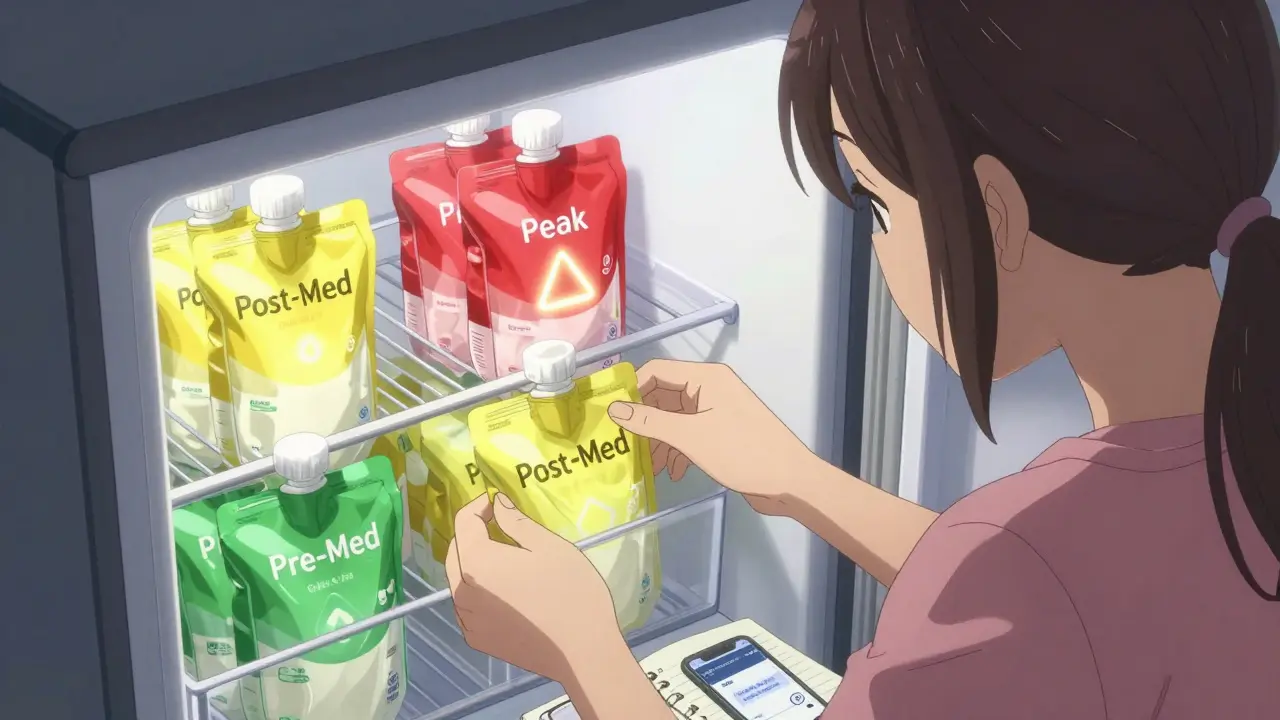
- Use separate bins or boxes labeled “Pre-Med,” “Peak,” “Post-Med.”
- Put the “Peak” milk in the back-where it’s coldest-and label it clearly with a red marker.
- Keep “Pre-Med” and “Post-Med” milk together in the front for easy access.
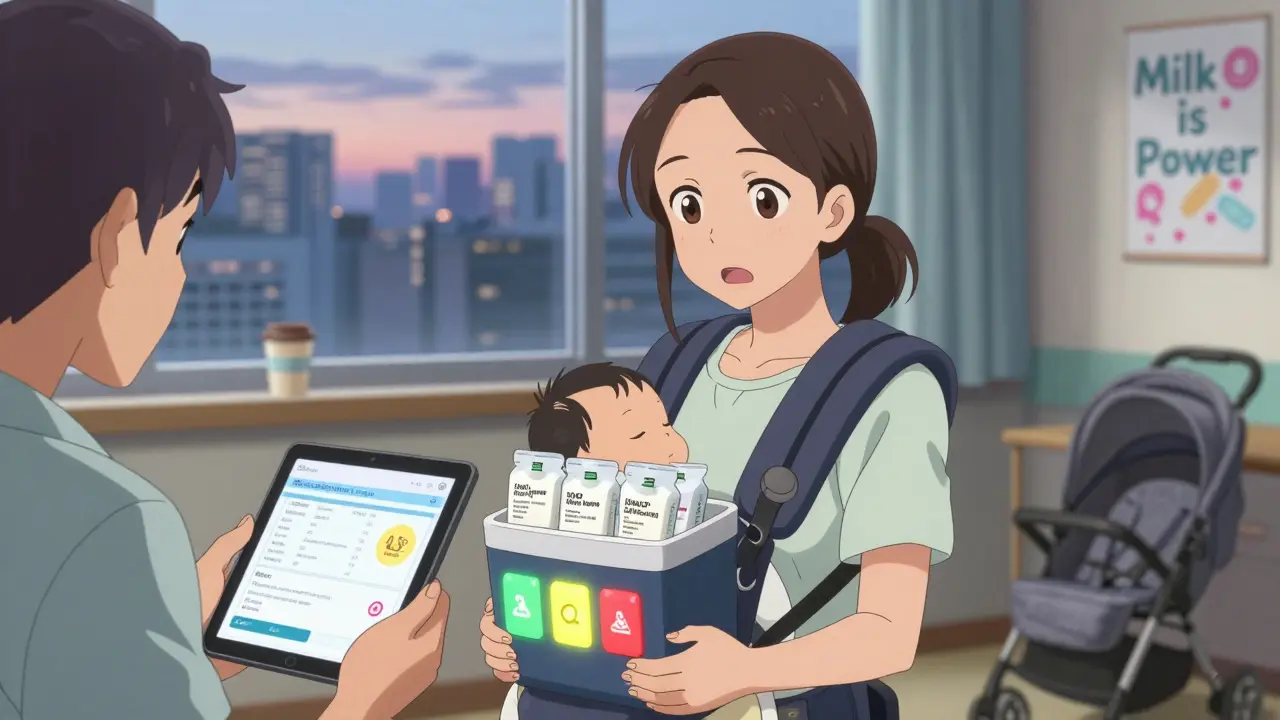
If you’re traveling or out of the house, use an insulated cooler with ice packs. The CDC says this keeps milk safe for up to 24 hours. Pack your labeled milk bags in a zip-top bag so they don’t get wet. If you’re pumping at work or on the go, carry a small notebook to jot down the time you pumped and when you took your pill.
What to Do When You’re Uncertain
Not every doctor knows the details of milk storage with meds. That’s why so many mothers end up confused.
Here’s what to do:
- Ask your pharmacist. They’re trained in drug transfer into breast milk. Say: “I’m breastfeeding. How does this affect my milk?”
- Call an IBCLC (International Board Certified Lactation Consultant). Many hospitals offer free consultations. They can help you map out your storage plan.
- Use trusted apps: MotherToBaby, LactMed (from NIH), or the ABM app. These are updated yearly and based on peer-reviewed studies.
- Never rely on Reddit, Facebook groups, or random blogs. They’re full of myths.
A 2022 survey by the International Lactation Consultant Association found that mothers who got personalized advice from an IBCLC wasted 37% less milk than those who guessed. That’s not just money-it’s nutrition, comfort, and peace of mind.
Real-Life Example: A Mom on Antibiotics
Sarah, a mom in Seattle, took amoxicillin for a sinus infection. She didn’t know what to do. She called her lactation consultant and got this plan:
- She took her pill at 8 AM.
- She pumped and saved milk from 6-7 AM: labeled “Pre-Med A.”
- She pumped at 9 AM: labeled “Peak 1.” (Discarded this batch.)
- She pumped at 2 PM: labeled “Post-Med A.” (Kept and used.)
- She repeated the same pattern for the next two doses.
She ended up using 90% of her stored milk. She didn’t have to stop nursing. She didn’t have to buy formula. She just followed a simple system.
Common Mistakes (And How to Avoid Them)
Here are the top mistakes mothers make-and how to fix them:
- Mistake: Mixing all milk together. Solution: Always separate by timing. Use different colored bags or labels.
- Mistake: Throwing out milk just because you took medicine. Solution: Check the drug’s safety rating first. Most are safe.
- Mistake: Forgetting to label. Solution: Label right after pumping. Set a phone reminder if needed.
- Mistake: Using old containers. Solution: Use food-grade plastic or glass with tight lids. Avoid regular freezer bags-they leak.
- Mistake: Waiting too long to use thawed milk. Solution: Once thawed, use within 24 hours if kept cold. Never refreeze.
One mom in Oregon told her story on Reddit: she forgot to label her milk and ended up feeding her 3-month-old a batch of milk from peak drug time. The baby got fussy and had a loose stool. It wasn’t dangerous-but it was scary. She now uses color-coded stickers and never forgets again.
What’s Changing in 2026
The field is evolving. In 2025, the FDA plans to start requiring medication labels to include breastfeeding storage instructions. That’s a big step forward.
Meanwhile, companies are making better storage bags with built-in label spaces for medication names and times. Apps are getting smarter too. MotherToBaby now syncs with your calendar and reminds you when it’s safe to feed again.
But until then, you’re the expert on your body. You know your baby. You know your schedule. Use the tools. Ask for help. And don’t let fear make you quit breastfeeding.
Do I need to pump and dump every time I take medicine?
No, you don’t. Less than 2% of medications require you to discard breast milk. Most common meds-like ibuprofen, acetaminophen, penicillin, or amoxicillin-are safe. You only need to pump and dump if your provider specifically tells you to, and even then, it’s usually just for a few hours. Always check the drug’s safety rating before assuming you need to dump.
How long should I wait after taking medicine before feeding?
It depends on the medication. For most, you can feed 1-3 hours after taking it, which is when the drug peaks in your milk. But for some, like certain antidepressants or seizure meds, you may need to wait 4-8 hours. The best approach is to pump right before your dose, then wait until after the peak to feed. Use apps like MotherToBaby or ask your lactation consultant for the exact timing based on your drug.
Can I freeze milk that was pumped while on medication?
Yes, but only if it’s labeled correctly. Milk pumped before or after the peak concentration of the drug can be frozen safely. Milk pumped during the peak may need to be discarded, depending on the medication. Always separate batches. Never mix medication-affected milk with clean milk before freezing.
What if I accidentally mix medicated milk with regular milk?
If you mixed a small amount of peak-time milk with clean milk, it’s unlikely to harm your baby. Most medications transfer in very low amounts. But if you’re unsure, don’t feed it. Use it for cooking (like oatmeal) instead, or discard it. Going forward, use color-coded bags and label every container right after pumping to avoid this.
Where can I find reliable info on my specific medication?
Use trusted sources: the LactMed database from the National Library of Medicine, the Hale Medications and Mothers’ Milk app, or the MotherToBaby app (updated 2024). You can also call your pharmacist or an International Board Certified Lactation Consultant (IBCLC). Avoid forums, blogs, or social media groups-they often spread misinformation.







Jack Havard
February 10, 2026 AT 12:15 PMLet’s be real - if you’re labeling milk with color-coded stickers and batch numbers, you’re not breastfeeding, you’re running a pharmaceutical logistics operation. The FDA doesn’t require this. Your pediatrician doesn’t require this. But somehow, the internet turned milk storage into a CIA operation. I’ve seen moms cry because they used the wrong colored bag. This isn’t medicine. It’s performance anxiety dressed up as science.
Gloria Ricky
February 10, 2026 AT 18:38 PMOMG this was so helpful!! I was totally panicking when I had to take amoxicillin last month and dumped like 3 days of milk bc I didn’t know better 😭 now I’m using the colored stickers thing and it’s SUCH a weight off my mind. Also, the 2-4oz portions? Genius. I wish I’d known this sooner!!
Stacie Willhite
February 11, 2026 AT 10:51 AMI just wanted to say thank you for writing this. As someone who struggled with milk supply after my second baby, every drop felt like a victory. The idea of discarding milk because of a medication made me feel like I was failing - even when I knew logically it was probably safe. This guide didn’t just give me instructions, it gave me permission to trust myself again. You’re not alone.
Jason Pascoe
February 11, 2026 AT 23:38 PMAs an Aussie dad who’s helped his partner through this twice, I can confirm - the labeling system works. We used a Sharpie and a small notebook. No stickers, no bins, just clear notes. The key isn’t perfection, it’s consistency. And honestly? Most pharmacists don’t know this stuff either. I had to Google LactMed myself. Glad someone finally put it all together.
Sonja Stoces
February 12, 2026 AT 04:45 AMLet’s talk about the real issue: why are we even *allowed* to take meds while breastfeeding? I’ve seen studies where trace amounts of ibuprofen showed up in infant urine. What about long-term neurological effects? Who funded this ‘98% safe’ claim? Big Pharma? Also, why are we not talking about how formula is *technically* safer? Just saying. 🤔
Annie Joyce
February 13, 2026 AT 01:42 AMY’all. I’m a nurse and I’ve seen moms cry over a single ounce of dumped milk. This post? Pure gold. The color-coded system? I’ve been using it for years - green for ‘go’, yellow for ‘wait’, red for ‘nope’. Also, the freezer bins? Life-changing. I even made a printable label template for my group. DM me if you want it. And seriously - stop using regular freezer bags. They leak like sieves. Use those thick, double-seal bags. Your baby’s tummy will thank you.
Rob Turner
February 13, 2026 AT 19:15 PMThere’s something deeply human about this whole process - the way we turn milk into data, the labels, the colors, the spreadsheets. It’s not just about safety. It’s about control. In a world where so much feels unpredictable - sleep, hormones, toddler tantrums - we cling to this ritual of precision. Maybe that’s the real medicine here: not the pill, but the act of caring so fiercely that we catalog every drop.
Luke Trouten
February 15, 2026 AT 03:58 AMThe advice here is sound, methodical, and grounded in evidence. That said, I appreciate the nuance in acknowledging that not all healthcare providers are trained in lactation pharmacology. The suggestion to consult a pharmacist or IBCLC is not just prudent - it’s essential. The fact that so many mothers are left to navigate this alone speaks to a systemic gap. This guide doesn’t just inform - it advocates. Well done.