
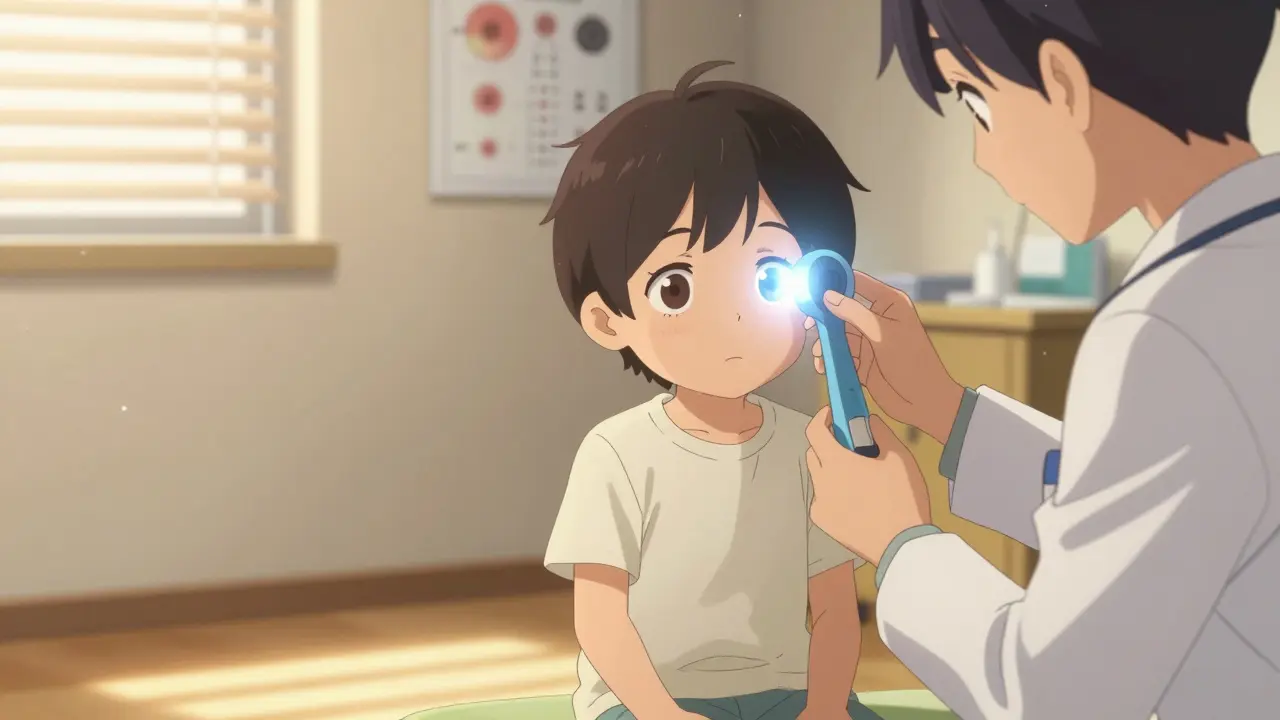
When your eyes don’t line up - one turning inward, outward, up, or down while the other looks straight - you’re dealing with strabismus. It’s not just a cosmetic issue. Left untreated, it can lead to permanent vision loss in one eye, trouble with depth perception, and even social anxiety. Around 5 out of every 100 children develop it, and adults aren’t immune either. Strokes, head injuries, and nerve damage can trigger it later in life. The good news? Most cases can be fixed, and surgery is often the most effective solution when glasses or patches don’t work.
What Does Strabismus Actually Look Like?
Strabismus isn’t one condition - it’s a group of eye alignment problems. The most common types are:- Esotropia - one eye turns inward (about half of all cases)
- Exotropia - one eye turns outward (30% of cases)
- Hypertropia - one eye drifts upward (15%)
- Hypotropia - one eye drifts downward (5%)
Some people have constant misalignment; others only notice it when they’re tired, sick, or looking at something far away. Kids might not say anything because they don’t know what normal vision feels like. Parents might notice their child squinting, tilting their head, or closing one eye in bright light.
Adults often notice double vision first - two images side by side, not one clear picture. That’s because their brains already learned to use both eyes together. When the eyes suddenly misalign, the brain can’t merge the images. Eye strain, headaches, and trouble reading are common. About 78% of adults with strabismus report discomfort around the eyes, and nearly 60% struggle with depth perception, making stairs, driving, or even pouring coffee harder than it should be.
Why Does Strabismus Happen?
Most of the time, it’s not a problem with the eye muscles themselves. It’s a brain issue. The brain sends signals to the eye muscles to keep both eyes locked on the same spot. If those signals get mixed up - because of genetics, nerve damage, or developmental delays - the eyes drift apart.Genetics play a big role. About 30% of children with strabismus have a close family member who had it. Premature birth, cerebral palsy, and Down syndrome also increase risk. In adults, strokes are the top cause. Trauma to the head or face can damage the nerves that control eye movement. Cranial nerve IV or VI damage leads to what’s called paralytic strabismus - sudden onset, often with dizziness and nausea. It makes up about 12% of adult cases.
Non-Surgical Treatments: When They Work (and When They Don’t)
Before surgery, doctors always try the least invasive options:- Corrective glasses - Especially for kids with farsightedness. Glasses can sometimes fix inward turning by reducing the focusing effort that pulls the eye in.
- Patching - Covering the stronger eye forces the weaker one to work. This helps prevent amblyopia, or lazy eye, which often develops alongside strabismus.
- Vision therapy - A series of exercises designed to train the eyes and brain to work together. It’s most effective for intermittent exotropia and mild cases.
But these don’t always fix the alignment. If the eye keeps drifting even with glasses on, or if double vision persists, surgery becomes the next step. Studies show that 60% of kids with intermittent exotropia can avoid surgery with vision therapy - but only if caught early. Once the misalignment becomes constant, the chances of success without surgery drop sharply.
Surgery: What Happens During the Procedure
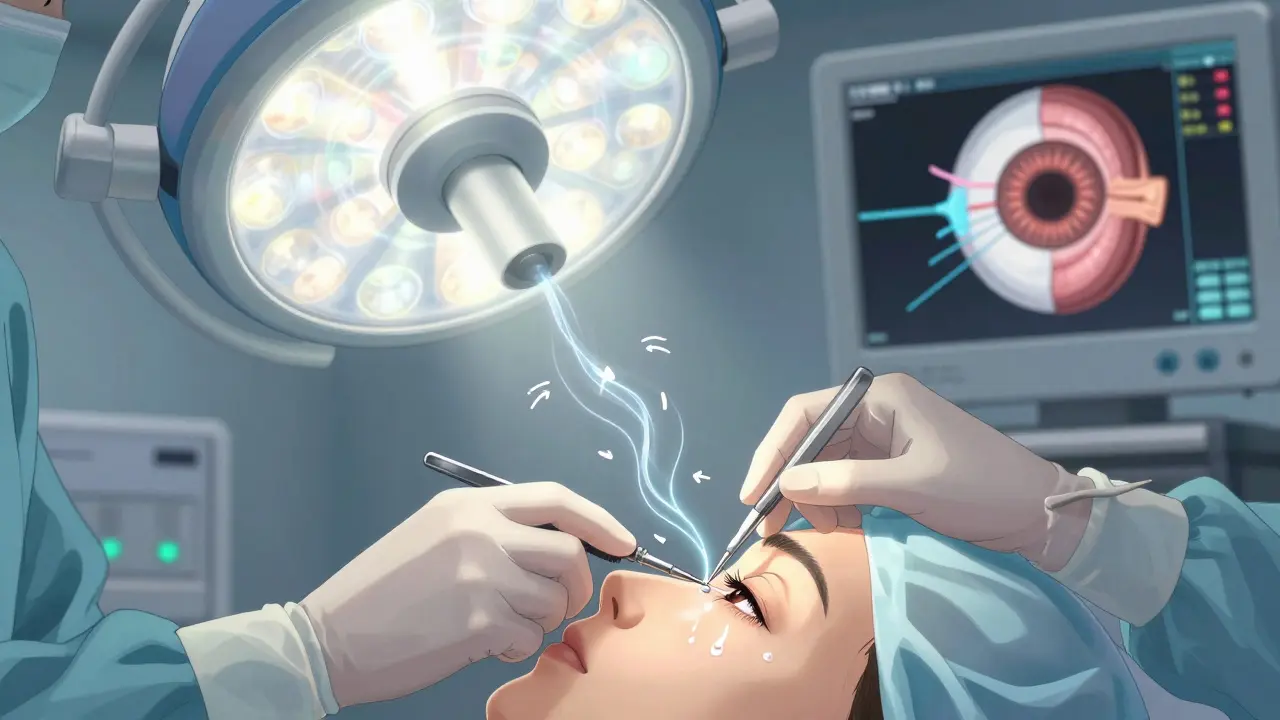
Strabismus surgery doesn’t remove or replace any part of the eye. It adjusts the muscles that control eye movement. There are two main techniques:- Recession - The surgeon detaches the muscle from the eye and reattaches it farther back, weakening its pull.
- Resection - The surgeon shortens the muscle by removing a small section and reattaching it tighter, strengthening its pull.
For inward turning (esotropia), the most common surgery is a bilateral medial rectus recession - weakening both inner eye muscles. For outward turning (exotropia), the outer muscles are tightened. The surgery takes 45 to 90 minutes. Children get general anesthesia. Adults usually get local anesthesia with sedation - they’re awake but relaxed and feel no pain.
Modern techniques use adjustable sutures in about 68% of adult cases. This means the surgeon doesn’t fully seal the muscle right away. The next day, the patient is brought back, the eye is numbed again, and the surgeon fine-tunes the position while the patient looks in different directions. It’s like calibrating a camera lens after the lens is installed.
Success Rates and What to Expect After Surgery
Success isn’t always perfect alignment. Doctors aim for alignment within 10 prism diopters - close enough that double vision and head tilting disappear. For children under 2, success rates are 75-85%. For adults, it’s 55-65%. About 20-30% of patients need a second surgery because the first didn’t fully correct the drift.Right after surgery, almost everyone has temporary double vision. That’s normal. The brain needs time to relearn how to use the eyes together. Most of it clears up in days or weeks. Some patients report redness, swelling, and mild pain - easily managed with eye drops and over-the-counter pain relievers.
Recovery takes time. You’ll need daily antibiotic and anti-inflammatory eye drops for two weeks. Follow-up visits happen at 1 day, 1 week, 3 weeks, and 6 weeks. Vision therapy often starts 4 to 6 weeks after surgery. It’s not optional - it’s critical. Patients who do therapy are 40% more likely to keep their alignment stable long-term.
Real Patient Outcomes: The Good, the Bad, and the Realistic
On patient forums and surveys, the sentiment is mostly positive. Eighty-two percent of adults who had surgery say it was “worth it.” Common comments:- “I finally made eye contact at work without feeling embarrassed.”
- “I could read again after 30 years of double vision.”
- “My kid stopped tilting his head - and now he doesn’t get teased at school.”
But it’s not magic. About 22% still have occasional double vision. 12% are unhappy with how their eyes look, even if they can see fine. And 15% of adults take longer than six weeks to recover fully.
One big mistake? Expecting surgery to fix everything. If your brain never learned to use both eyes together, you might still struggle with depth perception - even with perfectly aligned eyes. That’s why pre-op counseling matters. Patients who understand the limits of surgery report far higher satisfaction.
Who Performs the Surgery - And How to Find the Right Surgeon
Not every eye doctor does strabismus surgery. Only about 35% of general ophthalmologists have the training. You need a specialist with fellowship training in pediatric ophthalmology or neuro-ophthalmology. These doctors see hundreds of cases a year. The learning curve? Around 50 to 75 supervised surgeries before they’re truly proficient.Ask your eye doctor for a referral. If you’re in a major city, academic medical centers are your best bet. They have the latest tools, like the Steger hook with integrated force sensors (approved in March 2023), which lets surgeons measure muscle tension down to 0.5 grams. That kind of precision reduces the chance of over- or under-correction.
What’s New in Strabismus Surgery?
The field is evolving fast:- Virtual reality training before surgery boosts success rates by 18% - patients practice focusing both eyes together using VR games.
- Botox injections are now used as a temporary fix before surgery, reducing the amount of muscle adjustment needed.
- Robotic-assisted surgery is in early trials at Johns Hopkins. Early results show 32% greater precision in muscle placement.
- The American Academy of Ophthalmology now recommends surgery for infants as young as 3-4 months with severe esotropia - earlier than ever before.
These advances mean better outcomes, faster recovery, and fewer repeat surgeries. But access isn’t equal. In developed countries, 72% of kids with constant strabismus get evaluated by age 5. In developing nations, that number drops to 28%. Cost, awareness, and lack of specialists are the main barriers.
Insurance, Cost, and Getting Help
Strabismus surgery is usually covered by insurance because it’s medically necessary - not cosmetic. But insurers are tightening rules. Many now require proof that glasses, patches, or vision therapy failed for at least six months before approving surgery. Medicare cut reimbursement by 4.2% in 2023, which can affect how quickly some practices schedule cases.Out-of-pocket costs vary. In the U.S., surgery ranges from $4,000 to $8,000 per eye, depending on complexity and location. Nonprofits like NORA (Neuro-Ophthalmology and Strabismus Foundation) help low-income patients cover up to 100% of costs for 200-300 surgeries each year.
When to Act - And When to Wait
For kids: If you see constant misalignment before age 2, don’t wait. Early surgery gives the brain the best shot at learning to use both eyes together. Delaying past age 2 cuts the chance of developing normal depth perception in half.For adults: If double vision started suddenly - especially with headaches, dizziness, or weakness on one side - get checked immediately. It could be a stroke. If the misalignment has been stable for years and is just annoying, surgery is still an option - but make sure your expectations are realistic.
Strabismus isn’t something you grow out of. It doesn’t fix itself. But with the right treatment - whether glasses, therapy, or surgery - most people regain clear, comfortable vision and a better quality of life.
Can strabismus come back after surgery?
Yes, in about 20-30% of cases, the eyes drift again over time, especially if the underlying neurological issue wasn’t fully resolved. That’s why follow-up care and vision therapy are crucial. A second surgery is often needed and is usually successful.
Is strabismus surgery painful?
During surgery, you feel nothing. Afterward, there’s mild discomfort - like a scratchy or gritty feeling in the eye. Most people manage it with over-the-counter pain relievers and eye drops. The redness and swelling usually fade within a week.
Will I need glasses after surgery?
Maybe. Surgery fixes alignment, not focusing problems. If you were farsighted or nearsighted before, you’ll likely still need glasses. Some people even need a new prescription after surgery because their eyes are now working together better.
Can adults benefit from strabismus surgery?
Absolutely. While children have a better chance of regaining full depth perception, adults often see dramatic improvements in double vision, eye strain, and confidence. Many report being able to drive, read, or work again after years of struggle.
How long does recovery take?
Most people return to normal activities within 1-2 weeks. But full healing takes 6-8 weeks. Vision therapy, if recommended, usually starts 4-6 weeks after surgery and can last several months. Avoid heavy lifting and swimming for at least two weeks.
Is strabismus surgery risky?
It’s very safe. Serious complications like infection or retinal detachment are rare - less than 0.1%. The most common issue is temporary double vision, which affects 80% of patients but usually goes away. Undercorrection or overcorrection happens in 10-30% of cases and may require a second surgery.






Sue Latham
January 27, 2026 AT 11:36 AMI mean, if you're not getting adjustable sutures and VR pre-op training, are you even doing strabismus surgery anymore? 🤦♀️ I had my kid done at Mayo and they used the new Steger hook - it's like comparing a flip phone to an iPhone. If your surgeon hasn't done at least 50 cases, just walk away. No cap.
Also, why are people still trying patching for constant esotropia? That's like using duct tape to fix a leaky pipe.
Colin Pierce
January 28, 2026 AT 20:52 PMJust wanted to add - if you're an adult considering this, don't wait. I had double vision for 12 years after a concussion. Surgery wasn't a miracle, but it gave me back my life. I could read menus again. Drive without nausea. Made eye contact without feeling like a weirdo.
Vision therapy afterward? Non-negotiable. Did it for 3 months. Still do the exercises once a week. It's like physical therapy for your brain.
Mark Alan
January 30, 2026 AT 20:05 PMAMERICA STILL HAS THE BEST STRABISMUS SURGEONS IN THE WORLD 😤🇺🇸
Other countries? They're still using 1980s techniques. I read a guy from India had to wait 3 years just for a consult. Meanwhile here, my daughter got surgery at 5 months. THANK YOU, MEDICAL INDUSTRY. 🙏
Also BOTOX before surgery? GENIUS. Who else is doing this? 🤯
SRI GUNTORO
February 1, 2026 AT 10:07 AMIt's sad how we treat the body like a machine to be fixed instead of a sacred vessel. Why not try yoga, pranayama, or Ayurvedic eye drops before cutting muscles? Nature knows better than scalpels.
My cousin’s strabismus improved after 6 months of chanting Surya Namaskar. No surgery. No drugs. Just devotion.
Modern medicine forgets the soul.
Kevin Kennett
February 2, 2026 AT 07:22 AMListen, I get why people are skeptical - surgery sounds scary. But if you’ve got double vision, you’re not just ‘annoyed,’ you’re disabled. I used to spill coffee because I couldn’t judge depth. Now I pour a damn cup without thinking.
And yes, insurance fights you. They’ll make you jump through hoops. But push back. This isn’t cosmetic. It’s neurological. If they deny it, file an appeal. I did. Won.
Also - find a pediatric neuro-ophthalmologist. Not some general ophthalmologist who does cataracts on Tuesdays.
Jess Bevis
February 2, 2026 AT 10:46 AMSurgery works. Therapy helps. Wait too long, and the brain gives up.
Act early. Especially for kids.
Howard Esakov
February 2, 2026 AT 16:42 PMLet’s be real - if you're posting this on Reddit, you're probably already convinced surgery is the answer. The real issue? The fact that 72% of kids in the US get seen by 5, but only 28% in developing nations even get a glance.
It's not about medical tech. It's about capitalism. We have robots that measure muscle tension to 0.5 grams... but a kid in rural Nigeria dies because a $5 pair of glasses is 'too expensive.'
Fix the system, not just the eyes. 😒
Kathy Scaman
February 3, 2026 AT 18:37 PMMy dad had this surgery in '98. Came home with both eyes taped shut for a day. Thought he was blind. Turned out he just needed time to rewire. Now he says he sees colors differently - like everything’s sharper.
Also, he still does the eye exercises. Like, every morning. I think he’s obsessed.
He’s 72 now. Eyes still perfect.
Anna Lou Chen
February 4, 2026 AT 10:56 AMStrabismus isn’t a pathology - it’s a phenomenological rupture in the intersubjective gaze. The eye’s misalignment mirrors the fragmentation of the Cartesian self in late-stage visual capitalism.
Surgery attempts to reconstitute the optical hegemony, but at what cost? The brain’s neuroplasticity isn’t a bug - it’s a feature. Why force alignment when divergence could be a form of resistance?
Also, adjustable sutures? That’s just medical colonialism disguised as precision. Who decided 10 prism diopters is ‘acceptable’? Whose norm are we enforcing?
Let the eyes wander. Let them be free.
Mindee Coulter
February 6, 2026 AT 02:20 AMMy kid had exotropia. Patched for 6 months. Nothing. Surgery at 4. Now he doesn't squint. No more head tilting. Best decision ever
Timothy Davis
February 6, 2026 AT 20:57 PMLet’s cut through the fluff. You all act like this is some miracle cure, but the data’s messy. 20-30% need a second surgery. 22% still get double vision. 12% hate how their eyes look post-op.
And yet, everyone’s acting like it’s a guaranteed win. Where’s the nuance?
Also - who’s tracking long-term outcomes beyond 6 months? Most studies are funded by device manufacturers. That’s not science. That’s marketing.
And don’t get me started on ‘VR training.’ It’s a gimmick. You’re not training your eyes - you’re training your eyeballs to play a game. It’s not therapy. It’s gamified placebo.