

Beta-Blocker Safety Calculator
Your Risk Assessment
Enter your diabetes type and other risk factors to see how different beta-blockers affect your hypoglycemia risk.
When you're managing diabetes with insulin, your body already walks a tightrope between too much and too little sugar. Now add a beta-blocker-commonly prescribed for high blood pressure, heart disease, or irregular heartbeat-and that tightrope gets even narrower. The danger isn't always obvious. You might not feel your blood sugar drop. And that’s when things get life-threatening.
Why Your Body Stops Warning You
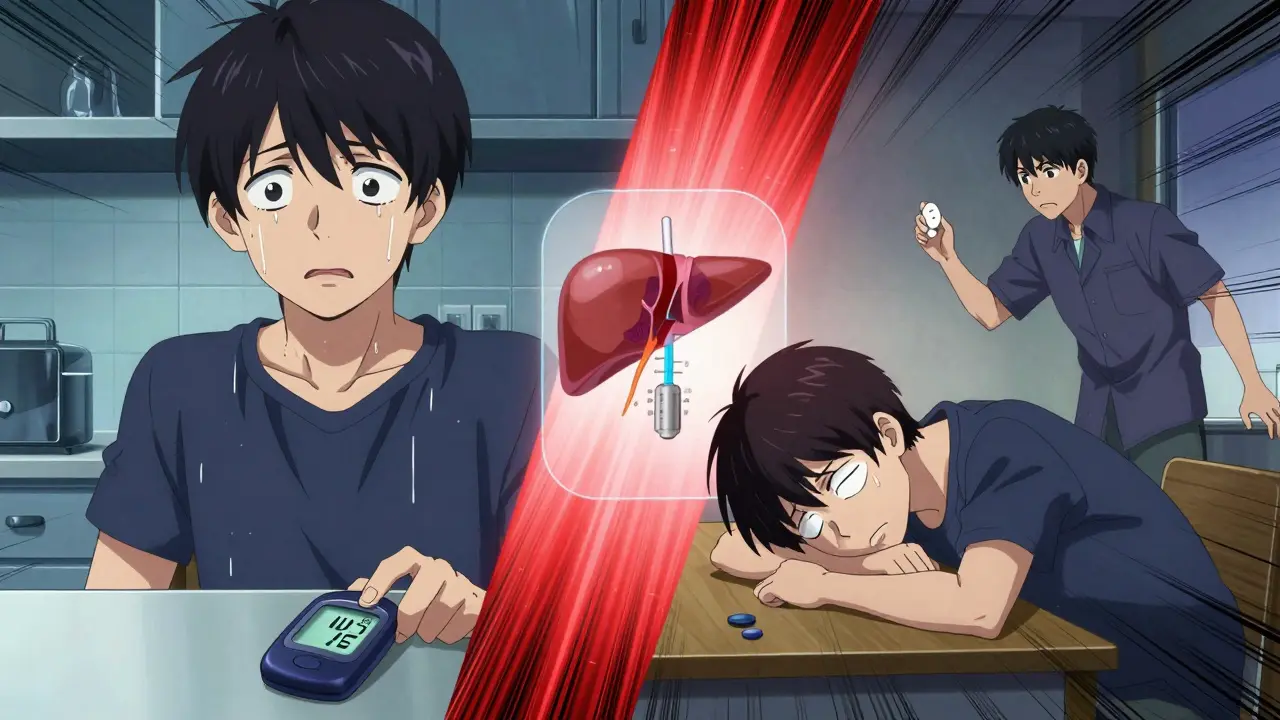
Normal hypoglycemia triggers a cascade of physical signals: your heart races, your hands shake, you break into a cold sweat. These are your body’s alarms telling you to eat something. But beta-blockers, especially the non-selective kinds, silence those alarms. They block adrenaline, the hormone that causes trembling and a pounding heart. That’s the whole point-they calm your heart rate. But in people on insulin, this means you lose the most reliable early warning signs.Here’s the twist: you still sweat. That’s because sweating is triggered by acetylcholine, not adrenaline. So if you start sweating without exertion or heat, that’s your body’s last, crucial signal. Many patients don’t know this. They think sweating means they’re overheated or anxious-not that their blood sugar is crashing.
The Real Risk: Silent Crashes
Hypoglycemia unawareness isn’t rare. About 40% of people with type 1 diabetes develop it over time, especially if they’ve had frequent low blood sugar episodes. The problem gets worse when beta-blockers are added. Studies show that in hospitalized diabetic patients, nearly 70% of dangerous low blood sugar events happen within the first 24 hours after starting a beta-blocker. That’s when the body is still adjusting.What makes this so dangerous is that without those warning signs, your blood sugar can plunge into the 30s or even 20s mg/dL before anyone notices. At that point, you’re not just shaky-you’re confused, disoriented, or even unconscious. Seizures and coma can follow. And unlike a typical low, you can’t treat it yourself. You need help.
Not All Beta-Blockers Are the Same
There’s a big difference between types of beta-blockers. Non-selective ones like propranolol block both beta-1 and beta-2 receptors. That means they shut down heart rate, tremors, and even liver glucose release. They’re the worst choice for someone on insulin.Cardioselective beta-blockers like metoprolol or atenolol mainly target the heart. They’re safer-but still risky. Studies show they still double the odds of hypoglycemia in hospitalized patients.
Then there’s carvedilol. It’s not just a beta-blocker-it also blocks alpha receptors. This gives it a unique edge. Research shows carvedilol is linked to significantly lower rates of severe hypoglycemia compared to metoprolol. One study found a 17% reduction in dangerous lows when patients switched from metoprolol to carvedilol. For people with diabetes and heart disease, carvedilol is now the preferred option in many guidelines.

How Beta-Blockers Make Low Blood Sugar Worse
It’s not just about hiding symptoms. Beta-blockers actually interfere with your body’s ability to fix low blood sugar. Normally, when your sugar drops, your liver releases stored glucose. Beta-blockers, especially those that block beta-2 receptors, stop that process. Your pancreas also releases less glucagon-the hormone that tells your liver to dump sugar. So your body can’t recover on its own.This dual problem-masked symptoms + impaired recovery-is why hypoglycemia in these patients is so severe. You don’t feel it coming, and your body can’t fix it. That’s why hospital mortality rates jump by 28% in patients on selective beta-blockers who experience low blood sugar. The risk isn’t just about discomfort. It’s about death.
What Doctors Should Do
If you’re on insulin and need a beta-blocker, your doctor should consider these steps:- Choose carvedilol first if you’re at high risk for hypoglycemia.
- Avoid non-selective beta-blockers like propranolol entirely if you’ve had hypoglycemia unawareness before.
- Check blood sugar every 2-4 hours during hospital stays, especially in the first day after starting the drug.
- Use continuous glucose monitoring (CGM) if possible. Since 2018, CGM use has grown 300% in this group-and it’s cut severe lows by 42%.
- Don’t assume normal symptoms mean normal sugar. Sweating is your only reliable signal now.
Even if you’re not in the hospital, your doctor should review your insulin dose and timing when starting a beta-blocker. You may need to reduce your mealtime insulin slightly, especially in the first week.
What You Can Do
If you’re on insulin and a beta-blocker, here’s what you need to know:- Know your sweat. If you suddenly break out in sweat-especially if you’re not hot or active-check your blood sugar immediately.
- Always carry fast-acting sugar. Glucose tablets, juice, or candy. Keep them by your bed, in your car, at work.
- Wear a medical alert bracelet. It says “Diabetes + Beta-Blocker” and “Risk of Hypoglycemia Unawareness.” That could save your life if you’re found unconscious.
- Teach someone close to you. Your partner, parent, or coworker should know you might not be able to ask for help. They need to recognize when you’re acting strange-not just tired, but confused or slurring words.
- Use CGM alarms. Set alerts for low and dropping trends. Don’t rely on how you feel.
What the Research Says About Long-Term Use
Some studies, like the ADVANCE trial, found no increase in severe lows over five years in patients taking atenolol compared to placebo. That’s reassuring for people on long-term outpatient therapy. But hospital data tells a different story. The danger spikes in acute settings-during illness, surgery, or when insulin doses are changed.The key takeaway? The risk isn’t the same everywhere. Outpatient life might be stable. But if you’re admitted to the hospital, you’re in a danger zone. That’s why protocols now require frequent checks during hospitalization.
The Bigger Picture: Heart Health vs. Blood Sugar Safety
This isn’t a simple “stop the beta-blocker” situation. People with diabetes have a 2-4 times higher risk of heart attacks and strokes. Beta-blockers cut post-heart attack death risk by 25%. For someone who’s had a heart event, stopping the drug could be deadlier than the low blood sugar risk.The answer isn’t to avoid beta-blockers. It’s to use them smarter. Choose the safest type. Monitor closely. Educate yourself. Use technology. That’s how you protect both your heart and your brain.
What’s Next? Personalized Medicine
Scientists are now looking at genetics to predict who’s most at risk. The 2023 DIAMOND trial is testing whether certain gene variants make some people far more likely to develop hypoglycemia unawareness on beta-blockers. If this works, doctors could someday test your DNA before prescribing and pick the safest option for your body-not just the standard one.Until then, the rules are clear: know your signals, trust your monitor, and talk to your doctor. You don’t have to choose between heart health and blood sugar safety. You just need to manage both-intelligently.





Travis Craw
January 16, 2026 AT 05:38 AMMan I never realized sweating could be a red flag like that. I thought it was just heat or stress. This is wild.
Bianca Leonhardt
January 16, 2026 AT 19:17 PMOf course the medical community waits until people are dropping like flies before they update guidelines. Beta-blockers have been killing diabetics quietly for decades. And now we’re supposed to be ‘grateful’ that carvedilol is ‘better’? Pathetic.
Christina Bilotti
January 16, 2026 AT 22:42 PMWow. Someone actually wrote a comprehensive post without saying ‘consult your doctor’ 17 times. Shocking. I’m assuming this was written by a nurse who got tired of cleaning up after people who ignored the 3rd paragraph of every discharge paper.
Also, ‘sweating is your only reliable signal’? Cute. Like your body’s emergency system is now a single smoke alarm in a 10,000 sq ft house. And you’re surprised when the whole place burns down.
Samyak Shertok
January 17, 2026 AT 12:41 PMSo let me get this straight - we’re being told to trust a machine over our own body because Big Pharma made our body’s alarm system obsolete? Brilliant. Next they’ll tell us to stop blinking because the camera on our phone does it better.
Also, ‘personalized medicine via DNA’? Sounds like the next step after ‘your blood type determines your personality.’
Allen Davidson
January 18, 2026 AT 04:37 AMThis is the most important post I’ve read in years. I’ve been on insulin for 12 years and metoprolol for 5. I had two silent lows last year - one landed me in the ER, the other I woke up from with my cat licking my face because I was unresponsive. No shaking. No sweating. Just… gone.
Switched to carvedilol 6 months ago. CGM on. No more scares. My cardiologist didn’t even know carvedilol had this advantage. I had to bring the study to him. That’s the problem - knowledge isn’t distributed, it’s hoarded.
If you’re on insulin + beta-blocker and you don’t have a CGM, you’re playing Russian roulette with your brain. And no, ‘checking 4x a day’ isn’t enough. Trends matter. Drops matter. The machine doesn’t lie.
john Mccoskey
January 19, 2026 AT 11:36 AMThe entire premise of this article is built on a fundamental misunderstanding of human physiology and pharmaceutical intent. Beta-blockers were never designed to be ‘safe’ for diabetics - they were designed to reduce cardiac mortality, and the trade-off was always understood. The real issue isn’t the drug, it’s the cultural delusion that medicine can eliminate all risk without consequence. We are not machines. We are biological systems with inherent vulnerabilities. The idea that we can ‘optimize’ every variable through technology, genetic screening, and algorithmic monitoring is not progress - it’s hubris dressed in white coats.
And let’s not pretend that CGMs are some miraculous salvation. They’re expensive, inaccurate during rapid fluctuations, and create a new class of anxiety disorders among patients who now obsess over every decimal point. The real solution? Stop medicating the symptoms of modern life - stop prescribing beta-blockers to people who are just stressed out, stop giving insulin to people who eat too much sugar, and stop pretending that biology can be managed like a spreadsheet.
People die because we treat medicine like a checklist, not a relationship. Your body isn’t a device to be calibrated. It’s a living, evolving organism. And you can’t hack evolution.
Ryan Hutchison
January 21, 2026 AT 04:45 AMLook, I get it. You’re scared. But this is America. We don’t cower behind CGMs and ‘sweating is your only signal’ nonsense. Back in my day, we just ate a candy bar when we felt weird. No doctor, no app, no genetic test. You want to live? Stop being a liability. Get off the insulin. Get off the beta-blocker. Or just die quietly. Either way, stop making everyone else feel guilty for not having a medical drone in their pocket.
Stephen Tulloch
January 21, 2026 AT 18:25 PMCarvedilol is the GOAT 🏆 for diabetics on BBs. I switched from metoprolol last year and my nocturnal lows dropped from 3x/week to 0. My endo didn’t even mention it - I had to push. Also, CGM + juice box in my car = life insurance. 🚗💨
Joie Cregin
January 22, 2026 AT 22:55 PMI’m a nurse and I’ve seen this happen so many times. One guy thought he was just ‘having a panic attack’ - turned out his BG was 28. He was smiling when we found him. Smiling. That’s the scariest part. You don’t scream. You don’t cry. You just… fade.
Thank you for writing this. Not everyone gets it. But the people who need to? They’ll read it. And maybe, just maybe, they’ll live.
evelyn wellding
January 24, 2026 AT 20:08 PMYESSSS this is so important!! 💪💖 I just got my CGM and I cried when it beeped for a low - I actually felt it this time! You’re not alone, friends. We got this! 🌈🩹
Melodie Lesesne
January 26, 2026 AT 00:07 AMMy dad’s on carvedilol now after his heart attack. He still forgets to check his sugar, but at least he doesn’t panic when he sweats. I just keep glucose tabs in his wallet. Small things, right?
Corey Sawchuk
January 27, 2026 AT 16:17 PMBeen on insulin and atenolol for 8 years. Never had a problem. Maybe I’m just lucky. Or maybe the stats are skewed by hospital cases. Either way I’m not changing anything
Rob Deneke
January 29, 2026 AT 12:41 PMYou’re not alone. I was scared too. But once I learned to read my CGM and stopped trusting how I felt? Everything changed. You got this. One low at a time.
vivek kumar
January 31, 2026 AT 00:27 AMInteresting how Western medicine treats this as a pharmacological problem rather than a systemic one. In Ayurveda, we’d say the liver and pancreas are out of balance due to stress, poor digestion, and sedentary lifestyle. Beta-blockers mask symptoms but don’t heal. The real solution? Movement. Fasting. Herbal support. But no, let’s just swap one pill for another and call it progress.